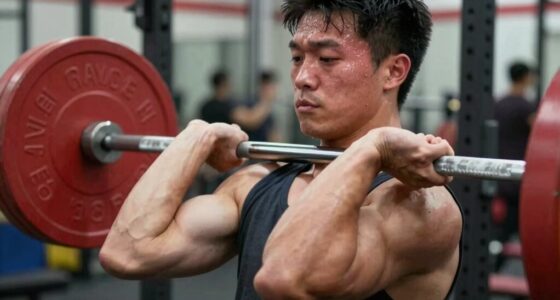
Initially, you’ll notice strength gains within a few weeks as your nervous system becomes more efficient. Visible muscle growth, or hypertrophy, usually appears after six to eight weeks of consistent training, with about 0.5 to 2 pounds of muscle gain per month for beginners. Factors like training frequency, recovery, and nutrition influence this timeline. Stick with it, and you’ll discover more about what to expect and how to optimize your progress.

Get workout gear delivered free with Prime
- Fast, free delivery on millions of items
- Prime Video, Amazon Music and more included
- Member-only deals all year
Key Takeaways
- Initial neuromuscular improvements occur within a few weeks, with visible muscle growth typically appearing after 6-8 weeks.
- Beginners can expect to gain about 0.5 to 2 pounds of muscle per month with consistent training.
- Training a muscle group 2-3 times weekly accelerates hypertrophy compared to less frequent workouts.
- Muscle growth happens primarily during recovery, emphasizing the importance of proper rest and nutrition.
- Long-term, muscle gains slow down, requiring patience, consistency, and ongoing proper training for continued progress.

Have you ever wondered how long it takes to see noticeable muscle growth? The truth is, patience is key, and understanding the process can help you stay motivated. Muscle hypertrophy, the scientific term for muscle growth, doesn’t happen overnight. It results from consistent training and proper recovery, but the timeline varies based on several factors. One of the most influential factors is training frequency. How often you work out each muscle group substantially impacts how quickly you’ll see results.
Muscle growth depends on consistent training, proper recovery, and training frequency. Patience is essential for visible results.
When you start a new strength training routine, your initial gains are often due to neuromuscular adaptations. That means your nervous system becomes more efficient at recruiting muscle fibers, making you feel stronger even before your muscles visibly grow. During this early phase, which can last a few weeks, you might notice increased strength and endurance but little noticeable change in muscle size.
Muscle hypertrophy takes a bit longer. Typically, you can expect to see some visible signs of growth around six to eight weeks into consistent training. However, this timeline depends heavily on your training frequency. Training a muscle group two to three times a week tends to promote faster hypertrophy because it provides more frequent stimuli for growth without overtraining. When you hit that ideal point with training frequency—balancing intensity, volume, and recovery—you maximize your potential for muscle gains.
It’s vital to remember that your body needs time to adapt and build new muscle tissue. Your muscles grow by recovering from the stress of lifting weights, which is why rest and nutrition are just as important as the workouts themselves. If you train too infrequently, your progress will likely slow down because your muscles don’t get enough stimulation. Conversely, training too often without proper recovery can lead to overtraining, injury, or burnout, stalling your progress altogether.
In the early stages, you might see rapid improvements in strength before noticeable size gains. As you continue, muscle hypertrophy becomes more gradual but steady. Expect about 0.5 to 2 pounds of muscle gain per month for most beginners, with more experienced lifters seeing slower but more refined growth. Remember, consistency in your training frequency, combined with proper nutrition and recovery, is what ultimately determines how long it takes to see meaningful muscle growth. Patience and persistence are your best allies on this journey.
Additionally, understanding the importance of training frequency and recovery can help optimize your workout plan for better results.
adjustable dumbbell set for muscle building
As an affiliate, we earn on qualifying purchases.
As an affiliate, we earn on qualifying purchases.
Frequently Asked Questions
Can Muscle Growth Occur Without Strength Gains?
Yes, muscle hypertrophy can occur without strength gains, especially in cases of strength independence. You might notice your muscles getting larger due to increased muscle fiber size, but your overall strength may not improve at the same rate. This can happen with certain training methods or when focusing on muscular endurance. Keep in mind, combining different training approaches can help synchronize muscle growth and strength development for balanced progress.
How Does Age Affect Muscle Growth Speed?
As you age, muscle growth slows down due to age-related decline and hormonal impact, like decreased testosterone and growth hormone levels. You’ll find it takes longer to see gains, and recovery may be tougher. However, consistent training, proper nutrition, and adequate rest can still promote muscle growth. While the process may be slower, staying dedicated helps you build strength and maintain muscle mass regardless of age.
Is Genetics a Major Factor in Muscle Building?
Genetics play a significant role in muscle building because your genetic predisposition influences your muscle fiber types, which affect how quickly you can grow. Some people have a higher proportion of fast-twitch fibers, allowing for faster gains, while others may see slower progress due to their fiber composition. While dedication and training are essential, understanding your genetics helps set realistic expectations and tailor your workout for ideal results.
How Long Should Rest Periods Be Between Workouts?
Think of your muscles like a finely tuned orchestra; they need rest between concerts. Rest periods should be about 48 hours between workouts targeting the same muscle groups to optimize recovery duration. This allows your muscles to repair and grow stronger. Adjust your workout frequency accordingly, ensuring you don’t overtrain. Proper rest enhances performance and helps you avoid injury, making every session more effective.
Can Supplements Significantly Speed up Muscle Growth?
Supplements can boost muscle growth, but their efficacy varies. While some, like protein powders and creatine, support muscle repair processes and may enhance gains, they won’t replace hard work and proper nutrition. You shouldn’t rely solely on supplements to speed up growth. Instead, use them as a complement to consistent training and a balanced diet, understanding that they offer marginal benefits compared to foundational habits.
As an affiliate, we earn on qualifying purchases.
Conclusion
Remember, your muscle growth journey is like planting a seed—patience and consistency nurture it into a mighty tree. While the process takes time, each workout and every effort adds a layer to your strength. Stay committed, trust the process, and celebrate small victories along the way. Before you know it, you’ll look back and see a forest of progress, a demonstration to your dedication and resilience blooming into the strongest version of yourself.
As an affiliate, we earn on qualifying purchases.
training journal for strength training
As an affiliate, we earn on qualifying purchases.
As an affiliate, we earn on qualifying purchases.
Halloween Picks
halloween
As an affiliate, we earn on qualifying purchases.