TL;DR

Get workout gear delivered free with Prime
- Fast, free delivery on millions of items
- Prime Video, Amazon Music and more included
- Member-only deals all year
A Fit&Well workout report recommends combining forward, side and curtsy lunges in a weekly lower-body session. The routine calls for 2–3 sets of 6–8 reps per side for each movement, with bodyweight or dumbbells and a bodyweight warm-up before adding load.
Fit&Well has outlined a three-movement lunge workout—forward, side and curtsy lunges—that can be performed once a week with bodyweight or dumbbells. The report recommends 2–3 sets of 6–8 repetitions per leg for each variation, presenting the routine as an option for working the glutes through different movement directions.
The workout is built around three lunges rather than a single squat-focused exercise. Fit&Well’s report says the variations train the gluteus maximus, medius and minimus, while also working other lower-body muscles. The report describes the gluteus maximus as the largest glute muscle, with the medius and minimus positioned deeper and helping with hip movement and pelvic stability.
For the forward lunge, stand with feet about hip-width apart, brace the core and step forward. Bend both knees to lower, aiming for roughly 90-degree angles while keeping the front knee over the foot and the chest upright. Push through the front foot to stand again. Complete 6–8 reps on each side, alternating legs or finishing one side before switching.
The side lunge starts from the same stance, but the step goes out to one side. Bend the stepping knee and send the hips back as far as is comfortable, keeping the opposite leg straight and the chest upright. For the curtsy lunge, step one foot back and across behind the other, then bend both knees before pushing through the front foot to return. The source advises keeping the trailing knee just above the floor only if that depth is comfortable.
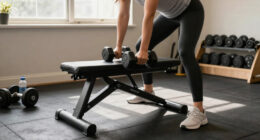
Readers can hold dumbbells at their sides or shoulders, or hold one weight at the chest; bodyweight is also an option. Fit&Well recommends doing a bodyweight round first when using weights, then increasing the load gradually over sets or across several weeks. The article suggests adjusting repetitions so the final few feel challenging, without prescribing a specific dumbbell weight.
Three Lunges Train Different Directions
The routine’s practical point is its mix of forward, lateral and crossing steps. These patterns challenge the legs and hips in different directions, rather than repeating one movement, and offer a compact structure for a weekly workout. Fit&Well says side and curtsy lunges also involve muscles and ligaments connecting the core and lower spine, and that the changing directions can support hip and ankle mobility and stability.
Those are the source’s stated training benefits, not evidence that this exact program will produce a particular result for every person. The report does not cite a trial comparing this sequence with other leg workouts or establish that once-weekly training is sufficient for everyone. Readers can use the plan as one component of a broader routine, adjusting resistance and range of motion to their ability.
Products Worth Considering

BowFlex Results Series SelectTech Adjustable Dumbbells, Pair

Bowflex SelectTech 840 Adjustable Kettlebell

Therabody JetBoots Prime Wireless Compression Boots – Short (under 29 inseam)
As an affiliate, we earn on qualifying purchases.
How the Weekly Plan Is Set Up
Fit&Well’s author presents the lunges as an alternative or addition to squats, noting that lunges can target parts of the glutes through movements squats may not emphasize in the same way. The report also recounts the author’s personal experience of finding the sequence helpful while rehabbing after a bulging-disc diagnosis. That account is personal experience, not a clinical finding or a recommendation to use lunges to treat a back condition.
The proposed dose is 2–3 total sets per exercise, with 6–8 repetitions per side in each set. The sequence may be part of a larger weekly program or performed on its own, according to the report. It does not set out a full training schedule, rest intervals, a target load or a progression plan beyond gradually increasing weight or repetitions as appropriate.
““The forward lunge, lateral (side) lunge and curtsy (reverse and rotational) lunge, together target all three muscles in your glutes.””
— Fit&Well report
Evidence and Individual Fit
The report does not identify a study testing this exact routine, explain how often the author’s suggested frequency was evaluated, or quantify expected strength or muscle gains. Its recommendations are a workout plan, not a guarantee of results. It also provides no individual guidance for people with injuries, balance difficulties or other health concerns.
Exercise technique and a suitable range of motion vary by person. Anyone with persistent pain, a recent injury or a diagnosed condition should seek guidance from a qualified health professional before beginning or changing a strength routine. Stop if a movement causes sharp or worsening pain, and use a stable, comfortable range rather than forcing depth.
Progress Load at Your Pace
There is no announced follow-up study or formal next milestone in the source report. Its suggested next step for readers is to begin with a bodyweight warm-up, select a comfortable variation and complete the three movements with controlled form. If adding dumbbells, increase the load gradually rather than starting with a weight that disrupts balance or technique.
Readers incorporating the sequence into a larger plan can track how the exercises feel and adjust repetitions, load or support as needed. The source gives no fixed timetable for progression, so any change should be guided by control and comfort rather than a deadline.
Key Questions
How often does the report recommend doing this workout?
Fit&Well presents it as a once-a-week workout option. The report does not establish that this frequency is ideal for every training goal or individual.
How many sets and repetitions should I do?
The suggested volume is 2–3 sets of 6–8 repetitions per leg for each of the three lunge variations.
Do I need dumbbells?
No. The routine can be done with bodyweight only. The report also suggests holding dumbbells at the sides or shoulders, or holding one weight at the chest, and recommends a bodyweight round first when training with weights.
What are the three exercises?
The sequence is a forward lunge, side lunge and curtsy lunge. Each uses a different stepping direction and is performed on both sides.
Is this workout suitable for someone with back or knee pain?
The source does not assess suitability for people with pain or existing conditions. Anyone with an injury or diagnosed health concern should seek advice from a qualified professional before trying the routine, and should stop any movement that causes sharp or worsening pain.
Source: fitandwell.com