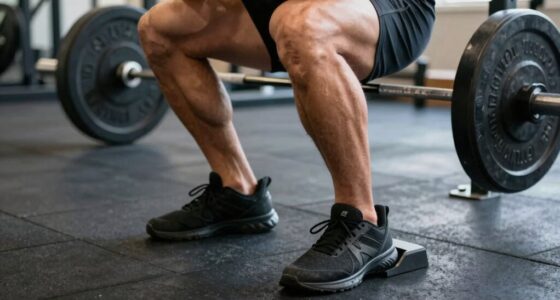
To improve knee and hip comfort during split squats, focus on proper alignment and muscle engagement. Position your feet shoulder-width apart before stepping forward, keeping your torso upright and hips level. Engage your core, activate your glutes and quads, and control your movement—descend slowly, avoiding overextension or leaning. Shifting weight onto the front heel and maintaining a straight line from head to back foot can also help. Keep these tips in mind to make your split squats more comfortable and effective.
Key Takeaways
- Maintain proper alignment by keeping hips level and knees tracking over toes during descent.
- Engage glutes and quadriceps to stabilize and reduce strain on knees and hips.
- Keep torso upright and distribute weight evenly between front heel and ball of foot for comfort.
- Control movement with slow, deliberate descents to prevent overextension and joint discomfort.
- Start with body weight or light weights, focusing on form to avoid unnecessary joint stress.
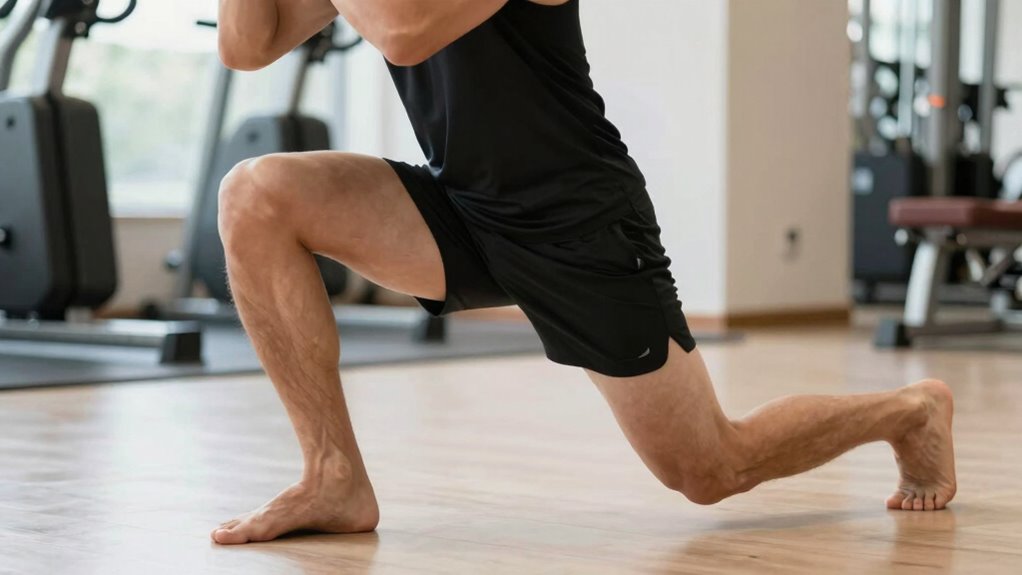
The split squat is a highly effective lower-body exercise that targets your quads, glutes, and hamstrings. To maximize its benefits, you need to focus on proper form, especially when it comes to muscle engagement and balance enhancement. When you step into the split squat, your goal is to activate the right muscles efficiently while maintaining stability throughout the movement. This involves carefully aligning your feet, hips, and knees to ensure each muscle group works as intended and to prevent unnecessary strain on your joints.
Start by positioning your feet shoulder-width apart, then step one foot forward into a lunge position. Keep your torso upright and your core tight, as a strong core plays a vital role in balance. As you descend into the squat, focus on engaging your quadriceps and glutes to control the movement. You should feel your thigh muscles working intensely, but avoid overextending your knees or leaning too far forward, which can compromise balance and place stress on your hips and knees. Proper muscle engagement here is key—by consciously activating your glutes and core, you create a stable foundation that enhances balance throughout the exercise.
Position feet shoulder-width apart, keep torso upright, and engage core for optimal balance and muscle activation.
Balance enhancement isn’t just about standing still; it’s about maintaining control and alignment. As you lower your body, imagine a straight line running from your head to your back foot. This visual helps you keep your hips level and prevents your front knee from caving inward. Keep your weight distributed evenly across your front heel and the ball of your foot, avoiding undue pressure on your toes or heel, which can destabilize you. As you press back up, focus on driving through your front heel, engaging your leg muscles fully to return to the starting position. This controlled, deliberate movement ensures muscle engagement is maximized while maintaining stability. Additionally, integrating balance exercises into your routine can help reinforce these skills outside of the split squat.
To improve balance and muscle engagement over time, start with a lighter weight or even just body weight. Pay close attention to your form, especially how your hips and knees move together. Small adjustments—like slightly widening your stance or shifting your weight—can make a significant difference in your comfort and effectiveness. Remember, the goal is to perform each repetition with precision, not speed, so that your muscles work efficiently and your joints stay protected. With consistent practice, these principles will help you refine your split squat form, improve balance, and deepen muscle engagement, leading to better strength gains and reduced risk of injury.

BODYRHYTHM Bulgarian Split Squat Stand, Single Leg Squat Roller Stand with 9 Adjustable Roller Heights for Squats, Leg Lunges, Lower Body Training. (Black)
【Multifunctional & Effective】Unlike double-legged squats, the instability of standing on one leg is not only perfect for performing…
As an affiliate, we earn on qualifying purchases.
As an affiliate, we earn on qualifying purchases.
Frequently Asked Questions
How Often Should I Perform Split Squats for Best Results?
You should perform split squats 2 to 3 times weekly for ideal results. Focus on training frequency that allows recovery and progression strategies like gradually increasing reps, weight, or sets. Consistency is key, so listen to your body and avoid overtraining. Incorporate proper form to prevent injury and improve gains. Adjust your routine as you get stronger to keep challenging your muscles and achieve better strength and stability.
Can I Do Split Squats if I Have Knee Pain?
You can do split squats even with knee pain, but prioritize knee pain management and joint health strategies first. Start with bodyweight exercises, focus on proper form, and avoid deep lunges to reduce strain. If pain persists, consult a healthcare professional. Incorporating gentle stretches and strengthening surrounding muscles supports joint health, making split squats safer and more effective as your knee recovers.
What Equipment Do I Need for Proper Split Squat Form?
You only need basic equipment for proper split squat form, like a sturdy bench or elevated surface for your back foot, and optionally, dumbbells or a barbell for added resistance. Use setup tips like positioning your front foot firmly on the ground and keeping your torso upright. Make certain your back foot is stable on the bench or platform, and maintain good posture for knee and hip comfort during the exercise.
How Can I Modify Split Squats for Limited Flexibility?
If your flexibility is limited, start by modifying your split squat stance—reduce the distance between your feet and focus on gentle stretching routines to improve flexibility. Incorporate regular flexibility exercises like hip openers and hamstring stretches into your routine. As your flexibility improves, gradually deepen your squat and adjust your stance for better form and comfort. Consistency with stretching routines will lead to better mobility and more effective split squat performance.
Are There Common Mistakes That Lead to Injury During Split Squats?
Yes, common mistakes like poor alignment and balance errors can cause injuries during split squats. You might hurt yourself if your knees drift past your toes or your hips tilt unevenly, placing stress on joints. To avoid this, focus on maintaining proper alignment, keeping your core engaged, and ensuring your balance is steady. These small adjustments help prevent strain and keep your workout safe and effective.

Dr. Arthritis Doctor Developed Strengthening Stabilizing Hip Brace for Men Women,Compression Wrap for Hip Pain,Hips Support Brace,Thigh Supports With Handbook, hamstring brace(LXL, Black)
DOCTOR DEVELOPED STABILIZING HIP BRACE: Our hip support brace is designed by doctors to provide optimum support &…
As an affiliate, we earn on qualifying purchases.
As an affiliate, we earn on qualifying purchases.
Conclusion
Mastering proper split squat form is the key to easing knee and hip discomfort. When you focus on your stance, keep your core engaged, and avoid rushing, you’ll see improvements faster than you might expect. Remember, Rome wasn’t built in a day—so don’t get discouraged if it takes time. Stick with it, listen to your body, and you’ll be on the path to greater comfort and better gains. Keep at it, and you’ll reap the rewards!
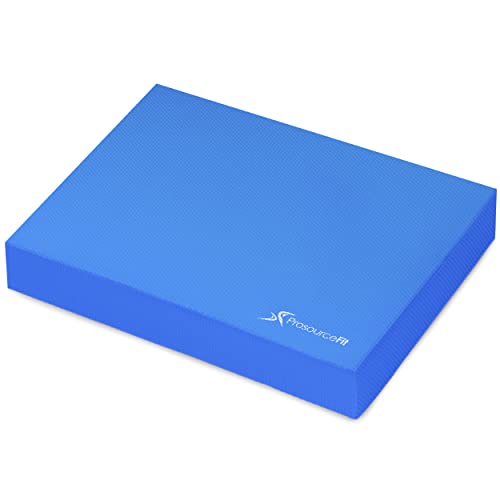
ProsourceFit Exercise Balance Pad – Non-Slip Cushioned Foam Mat & Knee Pad for Fitness and Stability Training, Yoga, Physical Therapy 15.5”x12.75”, Blue
IMPROVE BALANCE & STRENGTH – Foam creates unstable surface for working on balance & core strength, which also…
As an affiliate, we earn on qualifying purchases.
As an affiliate, we earn on qualifying purchases.
BODYRHYTHM Bulgarian Split Squat Stand, Single Leg Squat Roller Stand with 9 Adjustable Roller Heights for Squats, Leg Lunges, Lower Body Training. (Black)
【Multifunctional & Effective】Unlike double-legged squats, the instability of standing on one leg is not only perfect for performing…
As an affiliate, we earn on qualifying purchases.
As an affiliate, we earn on qualifying purchases.