
TL;DR

Get workout gear delivered free with Prime
- Fast, free delivery on millions of items
- Prime Video, Amazon Music and more included
- Member-only deals all year
Fit&Well published a senior personal trainer’s 10-minute, no-equipment home circuit, built around chair squats, wall push-ups and standing knee-to-elbow movements. The trainer recommends three rounds of 10 repetitions per exercise, but the routine is guidance from the article—not a personalized exercise plan or a guarantee of results.
Fit&Well has published a 10-minute, no-equipment workout that a personal trainer says they give clients over 60 to do at home between training sessions. The circuit uses chair squats, wall push-ups and standing knee-to-elbow movements, with the source recommending three rounds of 10 repetitions per exercise and brief rests.
The workout is presented as a full-body circuit: participants complete 10 repetitions of each exercise, then start the circuit again. Three rounds are expected to take around 10 minutes when rests are brief, according to Fit&Well. The article says taking longer at first is acceptable and suggests continuing to practice until less rest is needed. That timing is an estimate, not a requirement.
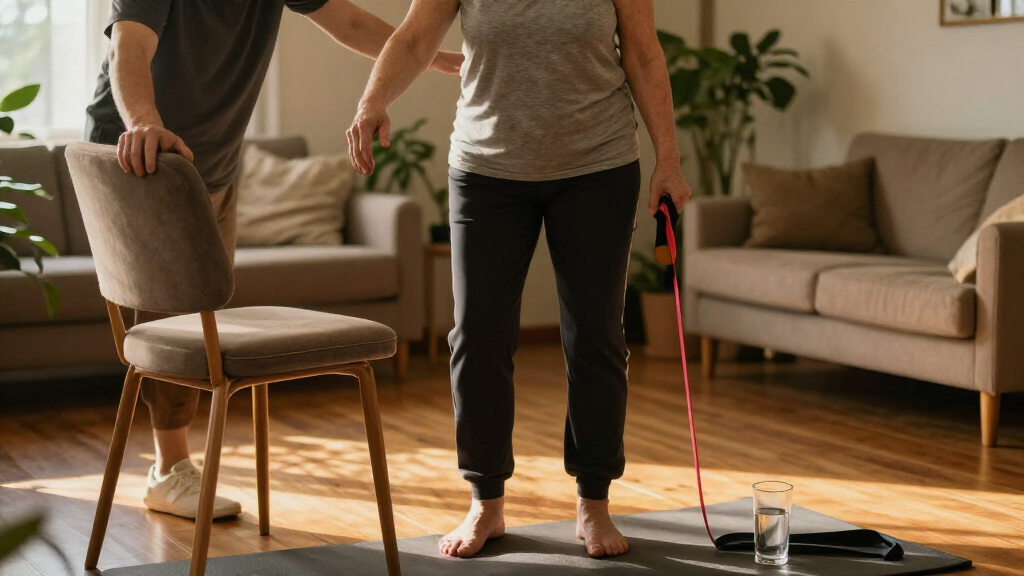
For chair squats, stand with a chair behind you, lower your hips toward the seat and stand again. The trainer advises keeping the spine from rounding or arching. People who find the movement difficult can sit fully before standing, and may hold a wall or another stable support. For wall push-ups, place both hands against a wall, bend the elbows to bring the chest closer, then push back. The article says moving closer to the wall makes the exercise easier; stepping farther away makes it harder.
The third movement is a standing knee-to-elbow exercise, alternating sides as each knee lifts and the opposite elbow moves toward it. The source recommends doing 10 repetitions per side. People with balance concerns can work one side at a time while holding a chair or wall. Touching elbow to knee is not required; the trainer says to use a comfortable range of motion and move slowly if lower-back issues are present.
A Short Routine With Support Options
The routine gives readers a simple structure for home movement that requires no equipment and includes ways to reduce difficulty. That can be useful for people seeking practical exercises between scheduled sessions, especially when access to a gym or equipment is limited. The source does not report research showing that this particular circuit improves strength, balance or health outcomes.
Its modifications also underline that a single routine will not suit every person. Balance, mobility, pain and exercise experience vary, including among adults over 60. A chair or wall can provide support, while a smaller range of motion or a seated version may make a movement more manageable. Readers should not treat the suggested repetition count or schedule as a target they must meet regardless of how they feel.
Products Worth Considering

Bowflex PR1000 Home Gym

Withings Sleep Under-Mattress Sleep Tracking Pad

Garmin Venu 3 Fitness Smartwatch, 45 mm, Black
As an affiliate, we earn on qualifying purchases.
How the Three-Move Circuit Works
The trainer’s routine is intended for use between in-person workouts, after clients ask what they can do at home. It focuses on three movement patterns: standing from a chair to work the lower body, pushing against a wall for the upper body, and coordinating a knee lift with a trunk movement. The source describes the exercises as beginner-appropriate, while warning that incorrect execution could cause pain or injury.
Fit&Well says to aim for the routine three to four times per week. It also suggests that people who split activity across the day could do sessions in the morning, afternoon and evening. These are recommendations from the article, not an individualized prescription. The source does not identify the trainer by name in the supplied material or provide information about the trainer’s credentials.
Limits of the Published Guidance
The supplied article does not name the trainer, give the publication date, cite studies on the circuit or explain how the exercise plan was tailored to individual clients. It also does not provide screening criteria for people with medical conditions, recent injuries, significant pain or limited mobility. There is no evidence in the source that the routine is appropriate for every adult over 60, and the stated 10-minute duration may vary with pace and rest.
The report describes the movements as beginner-appropriate but also says they could cause pain or injury if performed incorrectly. It does not set out what a reader should do if pain occurs or offer a complete alternative for each exercise. People who are unsure whether the movements are suitable should seek advice from a qualified health professional or trainer familiar with their needs. Stop if an exercise causes concerning pain, dizziness or unusual symptoms.
How Readers Can Approach the Routine
The published plan does not announce a follow-up study or a new training program. Readers considering the circuit can start with the supported versions described in the article, rest as needed and focus on controlled movement rather than finishing three rounds within a set time. A qualified trainer can check form and help adapt the movements, particularly for people who have balance difficulties or a history of back problems.
The source’s suggested frequency is three to four times weekly, but it does not explain how to adjust that schedule for different health circumstances. People with pre-existing conditions, recent injuries or concerns about starting exercise should consult a health professional before trying the routine. How well it fits an individual depends on their abilities and health; the article provides general guidance, not a personalized assessment.
Key Questions
What exercises are in the 10-minute workout?
The circuit includes chair squats, wall push-ups and standing knee-to-elbow movements. It requires no exercise equipment, although a chair and wall are used for the movements and support.
How many repetitions does the trainer recommend?
The article recommends 10 repetitions of each exercise per round, with 10 per side for the alternating knee-to-elbow exercise. It suggests completing three rounds, with brief rests, but says it is fine if the routine takes longer.
How often does the article suggest doing the circuit?
Fit&Well says to aim for three to four times per week. This is general guidance from the source, not a schedule tailored to an individual’s health or fitness level.
Can the movements be made easier?
Yes. The trainer suggests sitting fully before standing during a chair squat, holding a stable support if needed, and standing closer to the wall for easier push-ups. For balance concerns, the knee-to-elbow movement can be done one side at a time with a hand on a chair or wall.
Is the workout suitable for everyone over 60?
The source does not establish that it is suitable for everyone. It warns that incorrect form could cause pain or injury. People with pre-existing conditions, recent injuries, balance concerns or uncertainty about the movements should seek guidance from a health professional or qualified trainer before starting.
Source: rss