TL;DR

Get workout gear delivered free with Prime
- Fast, free delivery on millions of items
- Prime Video, Amazon Music and more included
- Member-only deals all year
A Fit&Well report recommends four exercises intended to build strength and balance for everyday activities: a seated knee lift with sit-to-stand, a dumbbell hold with leg raise, a farmer carry and a shoulder press. The suggested routine is two rounds, with eight repetitions per exercise or side and a 30-second carry; the report is an instructor’s guidance, not evidence from a clinical trial.
Fit&Well has published a four-move strength routine from a chair-workout instructor who teaches older adults, pairing seated knee lifts and sit-to-stands with a one-sided leg raise, a farmer carry and a shoulder press. The exercises are presented as ways to practise movements linked to daily independence, including standing from a seat, carrying groceries and reaching overhead.
The instructor says their regular class participants range from their late 60s to early 90s and attend because they want to manage everyday activities more independently. The report describes client experiences after training, including finding it easier to get into a car, walk farther or swim longer. These are individual accounts, not measured study results.
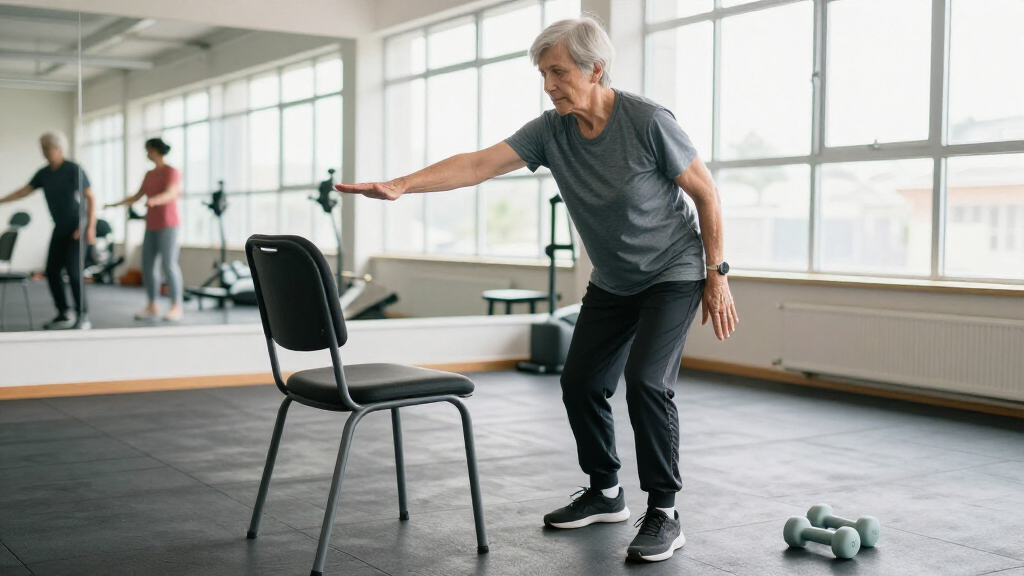
The suggested session uses a sturdy chair and a pair of dumbbells. The report recommends eight repetitions for each movement, or each side where applicable, and two rounds overall. For the farmer carry, it specifies 30 seconds per round, with 30 seconds of rest. It advises starting with weights that can be controlled throughout each movement.
For the first exercise, alternate seated knee lifts, then stand from the chair and sit back down with control. Next, hold a dumbbell in one hand while raising the opposite leg sideways, then switch sides. The farmer carry involves walking steadily with a dumbbell in each hand. The final move is a shoulder press, done seated or standing, pressing weights from shoulder height overhead without arching the lower back.
Training for Everyday Tasks
The routine is organized around practical movements rather than athletic performance: rising from a chair, stabilizing on one leg, carrying weight while walking and lifting objects overhead. Those actions can matter to people seeking to maintain independence as they age, though the article does not establish that this particular set of exercises prevents falls or guarantees that someone will remain independent.
The instructor links the moves to specific muscle groups and tasks. Sit-to-stands work the thighs and glutes, while the seated knee lifts practise moving the legs. The one-sided leg raise challenges balance, the carry tests grip and carrying ability, and the press targets the shoulders and arms. The value for readers is a clear, modest template they can adapt, rather than a claim of proven results for everyone.
As an affiliate, we earn on qualifying purchases.
How the Four Moves Were Chosen
The report is based on the instructor’s experience leading chair-based classes for older adults, alongside the instructor’s observations of participants’ progress. One client, the instructor says, had a nurse comment on her upper-body strength after a hip replacement; other examples concern getting into a car or walking farther. The report does not provide the clients’ names, formal assessments or details that would allow those outcomes to be independently evaluated.
Its stated rationale is to practise skills people may use later in life, including getting out of a low seat and carrying shopping. The instructor also recommends building strength in people’s 40s and 50s as preparation for later years. That is advice from the report’s author, not a finding attributed to a specific long-term study in the supplied material.
As an affiliate, we earn on qualifying purchases.
Evidence and Personal Suitability
The supplied report does not cite a clinical trial or compare this routine with other programs, so it does not show how much the exercises improve strength or balance, or whether they reduce falls. The client examples are personal accounts; the report gives no measurement method or comparison group. It also does not specify a schedule for how often to repeat the two-round session.
Individual ability, balance, joint problems and comfort with weights vary. The report does not set out modifications for particular conditions or explain when someone should seek professional advice. Readers who are new to exercise, have a health condition or feel unsteady may need guidance from a qualified health professional or exercise instructor before trying the routine.
balance training equipment for elderly
As an affiliate, we earn on qualifying purchases.
As an affiliate, we earn on qualifying purchases.
Adapting the Routine Safely
The report provides a routine, not a staged training plan or a promised follow-up. Anyone considering it can begin by choosing light weights they can control, using a stable chair for support when needed and stopping if a movement causes pain or unusual symptoms. For the carry, clear the walking area and use a load that does not make the body lean to one side.
People who need individual adaptations can ask a qualified exercise professional or healthcare provider for guidance. The article offers no confirmed next milestone, such as a scheduled update or new research; whether the routine suits a particular reader remains a matter of individual ability and circumstances.
As an affiliate, we earn on qualifying purchases.
Key Questions
What are the four recommended exercises?
The routine includes a seated knee lift followed by a sit-to-stand, a dumbbell hold with a side leg raise, a farmer carry and a shoulder press.
How many repetitions and rounds does the report suggest?
It suggests eight repetitions for each exercise or side, with two rounds overall. The farmer carry is timed for 30 seconds per round, followed by 30 seconds of rest.
What equipment is needed?
The routine calls for a sturdy chair and a pair of dumbbells. The instructor advises choosing weights that can be controlled throughout each movement.
Does the report prove these exercises prevent falls?
No. The article gives an instructor’s rationale and individual client accounts, but it does not cite a trial showing that this routine prevents falls or guarantees improved independence.
Should someone with balance or health concerns try it?
The report does not provide condition-specific adaptations. People who feel unsteady, have a health condition or are new to exercise should consider asking a qualified healthcare professional or exercise instructor for guidance before starting.
Source: rss
Halloween Picks
halloween
As an affiliate, we earn on qualifying purchases.