
TL;DR
A 2026 review combining 33 studies of 519 professional and amateur athletes found beet juice was associated with modest improvements in aerobic capacity and high-intensity performance, including power output. A dietitian cited in the report says benefits may depend on nitrate dose and taking it about two to three hours before exercise; the findings do not guarantee an individual performance boost.
A 2026 review of 33 studies involving 519 professional and amateur athletes found that beet juice was associated with modest improvements in aerobic capacity and high-intensity exercise performance, including power output. The findings suggest a possible workout aid, but the size of any benefit may depend on nitrate content, dose and timing, and the review does not establish that every athlete will improve.

Get workout gear delivered free with Prime
- Fast, free delivery on millions of items
- Prime Video, Amazon Music and more included
- Member-only deals all year
The review pooled research across 33 studies and 519 athletes in a range of sports. According to the Fit&Well report, the analysis found modest improvements in aerobic capacity and somewhat larger—though still modest—effects on high-intensity exercise and power output. The report said the results were consistent across the included studies, but did not provide individual study results or a single estimate of the expected benefit.
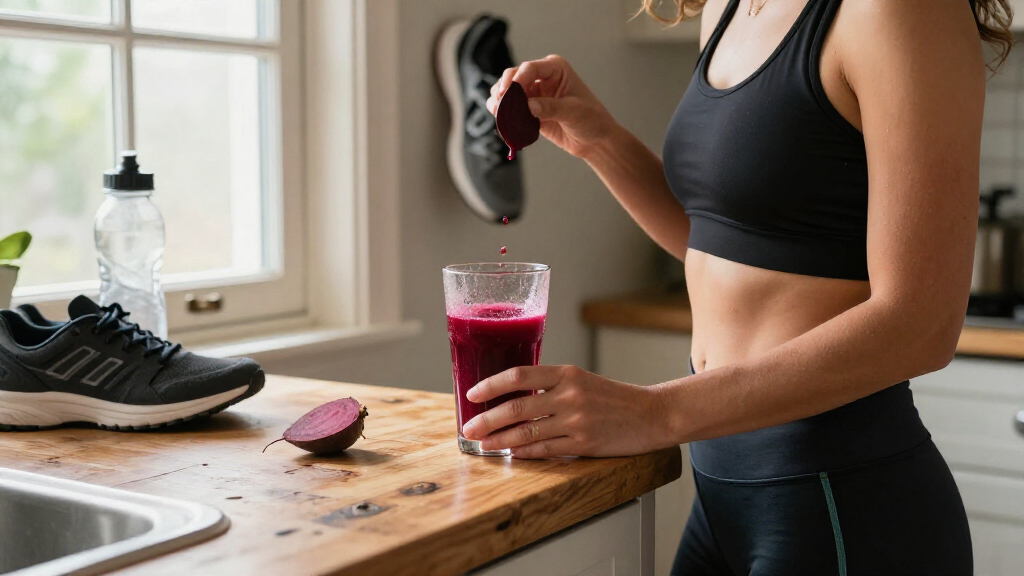
Registered dietitian nutritionist Theresa Gentile, a spokesperson for the Academy of Nutrition and Dietetics, explained that dietary nitrate in beet juice is converted in the body into nitric oxide. She said nitric oxide widens blood vessels and may affect blood flow, muscle oxygen use and contraction. Those processes offer a possible explanation for the performance findings; they do not mean beet juice will reliably improve an individual’s workout or prevent fatigue.
For dose, Gentile said much of the research uses 5–9 millimoles of nitrate, or about 300–600 milligrams. She noted that some recent evidence points to possible benefits at 8.3–16.4 millimoles, about 515–1,017 milligrams. These quantities refer to nitrate, not the volume of beet juice: products vary, and an ordinary grocery-store shot may not contain the same amount as a standardized sports product.
Potential Gains Beyond Endurance
The review’s reported effects extend beyond steady aerobic activities such as running, swimming and rowing. It also points to a possible modest effect on short, high-intensity exercise and power, which may be relevant to people training for efforts that require brief bursts of output. The report describes the power result as the review’s most notable finding, not as proof that beet juice produces a large or universal improvement.
For recreationally active people, the findings offer a way to understand why nitrate-rich beet products are marketed for sport, while setting realistic expectations. Gentile told Fit&Well that beet juice may modestly improve endurance and high-intensity performance, particularly for recreationally active individuals. The evidence summarized in the report does not establish how much a typical person would gain, whether the effect would change competition results, or whether a supplement is preferable to a varied diet.
Products Worth Considering

Garmin Forerunner 265 GPS Running Smartwatch, 46 mm, Black/Powder Gray

Garmin Forerunner 570 GPS Running Smartwatch, 42 mm, Aluminum Bezel, Bone/Mango

Oral-B iO Series 5 Rechargeable Electric Toothbrush with 5 Cleaning Modes, Travel Case, and 3 Brush Heads – Black
As an affiliate, we earn on qualifying purchases.
Nitrate Dose and Timing
Beets contain dietary nitrate, and nitrate-rich vegetables such as arugula and spinach also provide it. The proposed pathway described by Gentile is that the body converts nitrate into nitric oxide, a molecule involved in blood vessel function. Fit&Well also notes possible cardiovascular effects from nitrate-rich foods, including improved blood vessel function and modestly lower blood pressure in people with hypertension. Gentile said more research is needed on long-term dosing and on whether routine beet juice supplementation offers benefits beyond a healthy, vegetable-rich diet.
Gentile said research generally suggests consuming beet juice two to three hours before exercise, when nitric oxide levels are expected to be near their peak. Some studies have also reported benefits after daily intake for at least three days before an event, she said, although the report describes a single dose two to three hours beforehand as the more practical and consistently effective approach. The source does not give enough detail to compare specific products or establish that every preparation matches the study doses.
“Many sports-specific beet shots provide a standardized, research-backed dose of nitrate in a small volume.”
— Theresa Gentile, registered dietitian nutritionist and Academy of Nutrition and Dietetics spokesperson, quoted by Fit&Well
Limits of the Performance Evidence
The Fit&Well report summarizes the review but does not supply its full methods, the study-by-study results, or a detailed breakdown by sport, training level and dose. It is therefore not possible from the report alone to quantify an expected gain for a particular athlete or determine which subgroup benefits most. Consistency across studies, as described by the report, does not remove those limits or show that the effect is meaningful for every person.
Product nitrate content is another uncertainty: Gentile said ordinary beet juice and grocery-store shots can vary and may not supply amounts used in research. The report also does not establish the optimal long-term dose, whether supplementation adds value beyond a vegetable-rich diet, or the size of any cardiovascular benefit. People with health conditions or questions about supplements should seek advice from a qualified health professional before use.
What Athletes Can Watch For
The next useful evidence would clarify how results differ by exercise type, athlete experience, nitrate dose and product, and whether repeated use changes the effect. Until then, the report’s practical guidance is to check a product’s stated nitrate content rather than assume all beet shots are equivalent, and to treat the reported effects as potentially modest, not guaranteed.
Fit&Well also reported that a sports beet shot mentioned in its coverage was expected to become available in the United States in November through its website and Amazon; the report did not specify a year for that date. Readers should check current product availability and labeling. The broader questions about long-term supplementation and benefits beyond a healthy diet remain open.
Key Questions
What did the review find about beet juice and exercise?
The review summarized in Fit&Well covered 33 studies involving 519 athletes. It reported modest improvements in aerobic capacity and high-intensity performance, including power output. The report does not say that every participant or athlete would experience a benefit.
How much nitrate was used in the research?
Dietitian Theresa Gentile said much of the research suggests 5–9 millimoles of nitrate, equivalent to about 300–600 milligrams. She also cited some recent evidence suggesting 8.3–16.4 millimoles may produce greater performance benefits. Nitrate content varies among products, so those amounts do not translate into one universal serving size.
When should someone take beet juice before a workout?
Gentile said research generally suggests taking it two to three hours before exercise. Some studies have examined daily intake for at least three days before an event, but the report describes a pre-exercise dose as the practical, consistently effective approach in the evidence it discusses.
Will a regular grocery-store beet shot provide the same dose?
Not necessarily. Gentile said nitrate levels can vary between ordinary beet juice and shots, and some products may not provide the amounts used in research. Check the product’s nitrate information where available; the report does not verify the dose in every brand.
Is beet juice proven to improve performance for everyone?
No. The review reported modest average effects, and the source does not establish a guaranteed result for an individual or identify a certain benefit for every sport. Gentile said more research is also needed on long-term use and benefits beyond a healthy, vegetable-rich diet.
Source: rss