TL;DR

Get workout gear delivered free with Prime
- Fast, free delivery on millions of items
- Prime Video, Amazon Music and more included
- Member-only deals all year
Fit&Well published a beginner-friendly, four-move yoga flow created by Yogalina Studios founder Alina Boyett. The at-home sequence uses gentle poses and breathing to stretch commonly tense areas; its benefits are described by Boyett, not established as medical outcomes.
Fit&Well has published a four-pose yoga flow designed by Alina Boyett, founder of UK-based Yogalina Studios, for people seeking gentle movement after exercise or time spent sitting. The sequence requires no equipment or previous yoga experience; Boyett advises moving slowly, staying within a comfortable range and not pushing through pain.
The sequence includes waterfall pose, child’s pose, ragdoll forward fold and a seated spinal twist. Boyett says the movements target areas that commonly feel tense, including the legs, hips, spine and shoulders. The Fit&Well report presents the flow as a short at-home option for slowing down and reconnecting with the body.
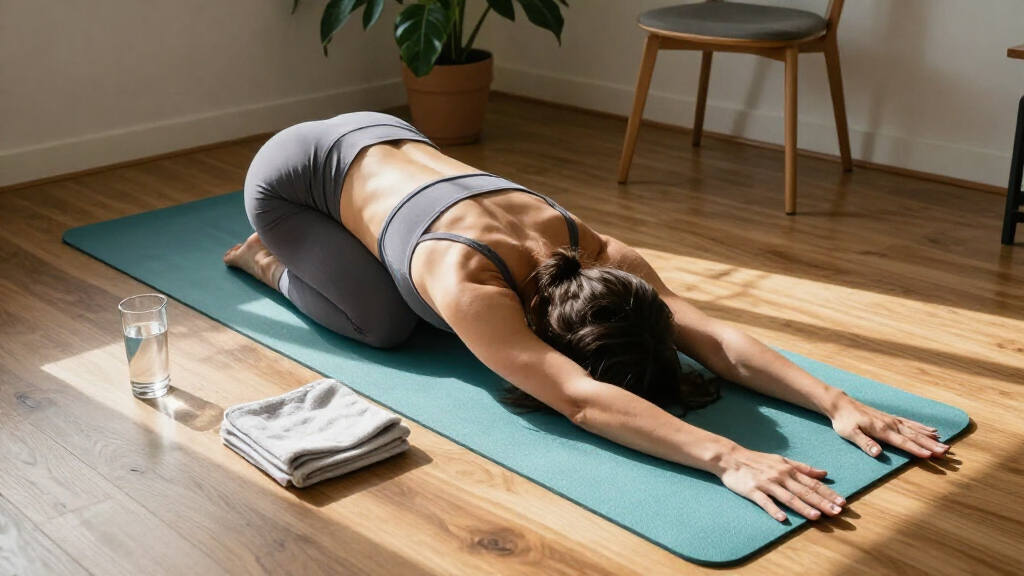
For waterfall pose, practitioners lie on their backs near a wall and rest their legs upward against it for three to five breaths, bending the knees if needed. Child’s pose also lasts three to five breaths: start on hands and knees, lower the hips toward the heels and extend the arms forward, resting the forehead on the floor if comfortable.
The final two movements are ragdoll forward fold, repeated for two rounds of three to five breaths, and a seated spinal twist, repeated on both sides for two to three breaths per side. The instructions call for softened knees in the forward fold and a gentle rotation in the twist. Boyett cautions against forcing any stretch and recommends professional guidance for people with an injury or relevant medical condition.
A Short Option for Active Recovery
The routine offers readers a structured, low-equipment way to add gentle movement to a recovery period, rather than treating recovery only as complete rest. Its four poses are described as accessible to beginners, and the breathing intervals make the sequence easy to follow without a long workout or specialized gear.
That accessibility does not establish that the flow will relieve pain, prevent injury or produce a specific flexibility gain. Boyett describes potential sensations and intended areas of focus; the source does not report clinical testing or measured outcomes. Readers can use the instructions as general movement guidance, while adjusting or stopping if a pose feels uncomfortable.
Products Worth Considering

Withings Sleep Under-Mattress Sleep Tracking Pad

Hyperice Normatec Elite Wireless Compression Boots Recovery – Standard Size

Withings Body Smart Wi-Fi and Bluetooth Smart Scale
As an affiliate, we earn on qualifying purchases.
Why Boyett Recommends Recovery Movement
Boyett’s recommendation is based on the view that exercise routines should leave room for recovery. She told Fit&Well that people often focus on how much or how intensely they move, while recovery is also part of maintaining a healthy, resilient body. She describes recovery as giving the body what it needs, rather than simply doing nothing.
The flow is intended for different situations, including after a challenging workout, a run or a day at a desk. Boyett says even a short period of mindful movement and breathing can change how someone feels. That is her advice and personal assessment, not a quantified finding in the report. The publication does not specify a required schedule or say that the sequence should replace other recovery practices.
Limits of the Reported Benefits
The report does not provide research findings, participant data or measured changes in flexibility, soreness or recovery. Benefits such as easing tension or encouraging relaxation are presented as Boyett’s descriptions of the poses, not as confirmed results for every person.
It is also unclear how often the sequence should be practiced, whether it suits particular injuries or health conditions, or how long the full routine takes beyond the stated breath counts. People with an injury or relevant medical condition are advised to seek professional guidance before trying it.
How to Approach the Sequence
The published instructions give readers a complete four-pose routine to try at home, with breath counts and basic positioning guidance for each movement. Anyone choosing to follow it can move at an unhurried pace, use modifications such as bent knees where suggested and stop if a pose causes pain.
Fit&Well’s source material does not announce a follow-up study, additional sequence or next publication date. The immediate next step for readers is to treat the routine as general, gentle movement guidance, not a substitute for individualized advice when health concerns or injuries are involved.
Key Questions
What poses are in Boyett’s yoga flow?
The four movements are waterfall pose, child’s pose, ragdoll forward fold and seated spinal twist. The instructions include breath counts for each and suggest repeating the forward fold and twist.
Do you need yoga experience or equipment?
Boyett describes the sequence as suitable for people without previous yoga experience and says it requires no equipment. Waterfall pose uses a wall as support.
Is the routine intended for after exercise only?
No. Boyett says it may be used after a challenging workout or run, or after spending the day sitting. The report does not prescribe a specific time or frequency.
What safety advice does the report give?
Move slowly, stay within a comfortable range, and do not force a stretch or push through pain. The report advises anyone with an injury or relevant medical condition to seek appropriate professional guidance before trying the sequence.
Are improvements in flexibility or recovery proven?
The report does not present clinical evidence or measured results. It describes Boyett’s intended use and views of the poses; individual effects are not established by the source material.
Source: fitandwell.com