Choosing a smart home gym often means deciding whether you want resistance generated by a machine or guidance built around real weights. Tonal mounts to a wall and uses motorized arms to provide digital resistance. Tempo pairs a screen and camera-based movement feedback with physical dumbbells, plates, or a barbell, depending on the package. Both aim to make home strength training more structured, but they solve different problems.

Get workout gear delivered free with Prime
- Fast, free delivery on millions of items
- Prime Video, Amazon Music and more included
- Member-only deals all year

Speediance Gym Monster 2 Smart Home Gym System
- ✔ Model: Gym Monster 2 Works Plus
- ✔ Maximum resistance: 220 lb
- ✔ Motors: Dual 800W PMSM brushless motors
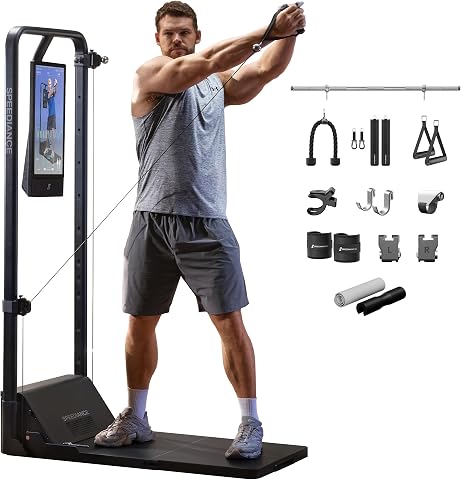
Speediance Gym Monster 2 Smart Home Gym
- ✔ Model: Gym Monster 2
- ✔ Maximum resistance: 220 lb
- ✔ Motor power: Dual 800W PMSM motors

FJÖR XT Trainer Compact Home Gym
- ✔ Model: XT Trainer
- ✔ Maximum resistance: 180 lb
- ✔ Resistance approach: Concentric digital resistance
Tonal is the stronger fit when floor space is scarce, you want quick changes in resistance, and a broad catalog of coached strength sessions matters more than using conventional weights. Tempo suits people who prefer the feel and flexibility of free weights and want visual coaching to help refine technique. The key tradeoff is compact convenience versus the familiarity and versatility of loading actual weights.
At a Glance
| Criteria | Tonal | Tempo | Winner |
|---|---|---|---|
| Resistance and equipment | Motorized digital resistance through wall-mounted arms; no conventional weight stack | Physical free weights paired with a screen and camera-based workout guidance | Depends |
| Space and setup | Wall-mounted unit needs suitable wall space, clearance, and professional installation | Needs floor space for the screen, workout area, and weight storage; setup varies by package | A |
| Coaching and feedback | Guided workouts with on-screen instruction and performance metrics | Trainer-led sessions with camera-based movement feedback, subject to view and exercise conditions | Depends |
| Exercise flexibility | Strong for coached strength movements supported by the arms and accessories | Free weights support familiar lifts and a wide range of movement patterns | B |
| Progression and convenience | Resistance changes quickly through software; settings and workout history support progression | Progress depends on selecting and changing physical loads; guidance can help track form and sessions | A |
| Cost and value | Premium equipment and membership costs; strongest value for frequent strength training in little space | Package pricing varies; can be worthwhile for users who will use both the weights and coaching | Depends |
Speediance Gym Monster 2 Smart Home Gym System
The Works Plus is our top pick because it combines the Gym Monster 2’s broad home-strength setup with an adjustable bench included. That makes it a more complete choice for buyers assembling a training space from scratch than the base Gym Monster 2, whose listed package omits a bench. Both Speediance versions share the stated 220-pound digital resistance, 1-pound adjustments, four resistance modes, and 2.69-square-foot folded footprint, so the Works Plus earns its place through package completeness rather than a different resistance engine.Its power cage, Smith machine, squat rack, and cable functions are intended to cover a wider range of lifts in one unit. Guided workouts and performance tracking add structure for people who want coaching built into their equipment. We should still account for setup: integrating the bench and other components takes assembly, and digital resistance can feel different from conventional free weights. The product description also flags dependence on software and AI features. Compared with the FJÖR’s concentric-only system, Speediance offers more stated resistance modes, but requires room, setup, and comfort with connected training.
Pros:
- Includes an adjustable bench with a broad set of training attachments.
- Offers up to 220 pounds of digital resistance with 1-pound adjustments.
- Four resistance modes support varied strength routines.
- Folds to a stated footprint of 2.69 square feet.
Cons:
- Assembly and integration of several components take time.
- Digital resistance may not feel like conventional weights to experienced lifters.
- Full use of AI and connected features depends on software and connectivity.
Best for: Home strength trainees who want a broad exercise setup, guided digital coaching, and an included adjustable bench in one package.
Not ideal for: Buyers who prefer traditional free weights, want minimal setup, or cannot accommodate the machine’s operating clearance and flooring needs.
Bottom line: For buyers who want one connected system to support varied home strength training, Works Plus offers the strongest combination of capability and included equipment.
“For buyers who want one connected system to support varied home strength training, Works Plus offers the strongest combination of capability and included equipment.”
Speediance Gym Monster 2 Smart Home Gym
When a bench is already part of our setup, the base Gym Monster 2 preserves the main reasons to consider Speediance: a multi-function strength station, up to 220 pounds of digital resistance, and a compact folded footprint. Its listed attachments cover barbell and cable-style movements, while AI coaching and resistance adjustments in 1-pound increments offer a guided route to structured progression. Compared with Works Plus, the key difference in the supplied details is straightforward: the adjustable bench is not included.That omission makes this version a more natural fit for someone who owns compatible equipment or has a specific bench plan. It may be less convenient for a first-time gym buyer who expects a complete training setup out of the box. Like its package sibling, it claims power cage, Smith machine, squat rack, and cable functions, with standard, chain, eccentric, and constant resistance modes. Its storage footprint is appealing for a small room, but folded dimensions do not eliminate the need for vertical clearance and sturdy flooring during use. The FJÖR is simpler in its resistance approach; this Gym Monster is the broader option, at the cost of more dependence on software and a missing bench.
Pros:
- Combines several strength station functions in one unit.
- Provides up to 220 pounds of resistance with fine 1-pound adjustments.
- AI coaching and guided workouts support structured training.
- Folding design has a stated 2.69-square-foot footprint.
Cons:
- Adjustable bench is not included in the base package.
- Needs adequate vertical space and sturdy flooring for operation.
- Software connectivity is part of the full feature experience.
Best for: Buyers who already own a suitable bench and want a compact, connected system with broad exercise options.
Not ideal for: People starting from an empty room who want a bench included, or lifters who want a purely mechanical setup.
Bottom line: The base Gym Monster 2 makes the most sense when we already have a bench and want the Speediance training system without duplicating that equipment.
“The base Gym Monster 2 makes the most sense when we already have a bench and want the Speediance training system without duplicating that equipment.”
FJÖR XT Trainer Compact Home Gym
The FJÖR XT Trainer stands apart by focusing on concentric digital resistance: it emphasizes the lifting phase and reduces resistance during lowering, according to the product description. That approach may suit users seeking a guided, space-conscious routine or a different feel from conventional strength equipment. Its app integration and library of more than 85 targeted workouts provide direction, while the stated 180-pound maximum is lower than the 220-pound ceiling on both Speediance models.That makes the XT a more specialized choice than either Gym Monster 2 package. Speediance lists multiple resistance modes and a combination of rack, Smith machine, and cable functions; FJÖR’s description centers on its resistance method and workout library. We should weigh the XT’s plastic construction against the more equipment-heavy Speediance descriptions, though the supplied information does not establish a direct durability comparison. The concentric-only limitation can also rule it out for people who want more conventional control over both lifting and lowering phases. For buyers who value the stated workout variety and app feedback over the higher resistance ceiling and broader stated modes, it offers a distinct training proposition.
Pros:
- Compact design is aimed at limited living spaces.
- App integration provides guided workouts and progress feedback.
- More than 85 targeted workouts are listed.
- Concentric resistance reduces strain during the lowering phase, according to the description.
Cons:
- Maximum stated resistance is lower than the Speediance models.
- Plastic construction may feel less substantial than a metal gym station.
- Concentric-only resistance may not suit every training style.
Best for: Space-conscious users who want app-guided workouts and are specifically interested in concentric-focused resistance.
Not ideal for: Lifters seeking more than 180 pounds of resistance, conventional eccentric loading, or a rack-style multi-function station.
Bottom line: The XT Trainer is a focused alternative for app-guided, concentric training, but Speediance is the stronger fit for buyers prioritizing higher resistance and broader stated modes.
“The XT Trainer is a focused alternative for app-guided, concentric training, but Speediance is the stronger fit for buyers prioritizing higher resistance and broader stated modes.”
As an Amazon Associate we earn from qualifying purchases.
Key Differences
The biggest practical divide is what supplies the load. Tonal uses motors and software to set resistance, which makes it fast to adjust between exercises and keeps the equipment footprint small. Tempo uses physical weights, so loading feels familiar and the available exercises are shaped by the weights and the room around them. For someone who values traditional lifting mechanics, that familiarity can matter more than a tidy wall installation. For someone fitting workouts into a small room, Tonal’s compact arrangement is a meaningful advantage.
Coaching is another point of separation. Tonal emphasizes guided sessions and workout data within its digital resistance system. Tempo adds camera-based feedback to training with free weights, which can offer useful form cues when the camera has a clear view and the exercise is supported. Neither system should be treated as a substitute for a qualified coach or medical advice, and feedback can vary by movement. The better choice depends on whether you prioritize software-managed resistance or visual guidance while using conventional equipment.
Value comes down to actual use. Both ask buyers to pay for equipment and a connected training experience, and membership terms and package costs can change. Tonal earns its premium for consistent users who will make use of guided programming and convenient resistance changes while saving room. Tempo can make more sense for lifters who already know they like free weights and will regularly use its coached sessions. If you mainly want occasional exercise or do not need connected coaching, neither premium setup is an automatic value.
Detailed Comparison
Resistance and equipment (major difference)
Tonal wins for quick, software-controlled changes: its motorized arms provide adjustable resistance without loading plates between sets. Tempo wins for the familiar feel of physical free weights and the direct relationship between the load selected and the weight lifted. This is a major difference in training experience. Pick Tonal for convenience and a compact resistance system; pick Tempo if using actual dumbbells or a barbell is central to how you like to train.
Space and setup (Tonal wins — moderate)
Tonal generally takes less floor space because the main unit mounts to a wall and its arms fold away, though it still requires a suitable wall, clearance, and installation. Tempo needs room to move around the screen and store or handle weights. The gap is moderate to major in a small apartment, where the free-weight area can be the limiting factor. Tonal is the more practical choice for tight rooms; Tempo is easier to accommodate when a dedicated workout area is available.
Coaching and feedback (moderate difference)
Both offer guided training, but they deliver it differently. Tonal integrates coaching and performance tracking with its digital resistance. Tempo adds camera-based movement feedback during supported exercises, which may help users notice technique issues but depends on camera placement and visibility. Neither wins for every learner, so the difference is moderate: choose Tempo if visible form cues are a priority, and Tonal if a connected resistance and workout-tracking experience matters more.
Exercise flexibility (Tempo wins — moderate)
Tempo has the edge for lifters who want conventional free-weight movements and the ability to handle weights directly. Tonal supports a wide range of coached strength exercises through its arms and accessories, but its movement options remain tied to that system. The difference is moderate: Tempo better matches familiar dumbbell and barbell routines, while Tonal offers a guided catalog within a more controlled setup. Check each model’s current accessory and exercise support against your routine before buying.
Progression and convenience (Tonal wins — moderate)
Tonal has the convenience advantage because resistance changes through software, which can make supersets and transitions between exercises smoother. Tempo uses physical loads, so changing weight takes handling equipment, though that process is familiar to most lifters and makes the load tangible. This is a moderate win for Tonal if workout pace matters. Tempo can be just as appropriate for users who prefer traditional loading and do not mind making the adjustment themselves.
Cost and value (major difference)
There is no universal value winner because package prices, memberships, and promotions vary. Tonal is worth paying more for when its compact footprint, digital resistance, and coached training will replace frequent gym visits or support regular home workouts. Tempo’s value improves when a buyer specifically wants real weights and will use the coaching features. If you will train only occasionally, the ongoing cost of either connected system may be hard to justify. This is a major personal-fit decision rather than a simple price comparison.
Tonal: Pros and Cons
Pros:
- Compact wall-mounted design preserves floor area
- Resistance changes quickly without moving plates
- Guided workouts and performance tracking are integrated with the resistance system
Cons:
- Requires a suitable wall and installation
- Digital resistance may not suit lifters who want conventional weights
- Premium equipment and membership costs can be poor value for infrequent users
Tempo: Pros and Cons
Pros:
- Uses familiar physical free weights
- Camera-based feedback can add technique cues during supported movements
- Fits lifters who want coached workouts alongside conventional loading
Cons:
- Needs room for a workout area and weight handling or storage
- Changing loads takes more effort than adjusting Tonal digitally
- Camera feedback depends on exercise support, placement, and a clear view
Who Should Choose What
Choose Tonal if:
- You have limited floor space but can mount a unit on a suitable wall.
- You want resistance to change quickly between exercises.
- You value guided strength sessions and connected workout tracking enough to use them regularly.
Choose Tempo if:
- You prefer dumbbells or a barbell over machine-generated resistance.
- You want camera-based movement feedback as part of guided workouts.
- You have a dedicated area for lifting and storing or handling weights.
Skip both if: You train only occasionally, prefer an unconnected routine, or can meet your needs with basic adjustable weights and free workout resources at a much lower cost.
Value for Money
Paying more for Tonal makes sense for a consistent home lifter who has limited space and will use its guided programs and fast resistance changes several times a week. In that situation, convenience may help turn planned workouts into actual workouts, and the wall-mounted design can make a home setup possible where a rack of weights would be cumbersome.
Tempo is better value for someone who specifically wants physical weights and will make regular use of its coaching and feedback features. Buyers should compare current equipment packages, membership requirements, warranty coverage, and installation costs before deciding; the headline price alone may not capture the full commitment. If connected guidance is not a priority, a simpler set of adjustable weights may deliver better value than either system.
Final Verdict
Choose Tonal if space is tight and you want a coached strength system with digitally controlled resistance that is quick to adjust. Choose Tempo if you want real free weights and prefer training with familiar equipment while receiving on-screen guidance. For most buyers who already enjoy lifting with dumbbells or a barbell, Tempo is the more natural fit; for small homes and users who value convenience above traditional loading, Tonal is the stronger purchase. The deciding factor is whether you want software to create the resistance or physical weights in your hands.
Frequently Asked Questions
Is Tonal better than Tempo for a small home?
Usually. Tonal mounts to a wall and folds away, while Tempo needs floor space for movement and its weights. Tonal still requires appropriate wall support, clearance, and installation, so check the room before ordering.
Which system is better for traditional strength training?
Tempo is the closer match because it uses physical free weights. Tonal can support many strength exercises, but its motorized resistance and arms feel different from loading a dumbbell or barbell.
Does Tempo correct lifting form?
Tempo provides camera-based feedback for supported exercises, but the quality of cues depends on camera visibility and the movement being performed. Treat it as guidance rather than a guarantee of correct technique.
Is either smart home gym worth the ongoing cost?
It can be if you train regularly and use the connected coaching features. Compare current membership terms and total package costs with how often you expect to work out; occasional users may get better value from simpler equipment.