TL;DR

Get workout gear delivered free with Prime
- Fast, free delivery on millions of items
- Prime Video, Amazon Music and more included
- Member-only deals all year
A Fit&Well report highlights muscular power—the ability to produce force quickly—as a fitness skill that may decline with age and inactivity. Trainer Kylie Hansen recommends controlled, low-repetition exercises that can be modified for different abilities; the report does not establish that this routine improves longevity or prevents falls.
A Fit&Well report is drawing attention to muscular power—the ability to produce force quickly—as a fitness quality women may overlook while focusing on strength training in midlife. NASM-certified trainer Kylie Hansen says power can matter for rapid movements such as recovering balance after a trip, and outlines a modifiable workout; the report does not show that the exercises extend lifespan or prevent falls.
Hansen defines power as using strength at speed. She says muscle fibers involved in quick, forceful movements can decline with age and inactivity, making it useful to practice producing force quickly as people get older. These are the trainer’s explanations in the report, not findings from a new study presented there.
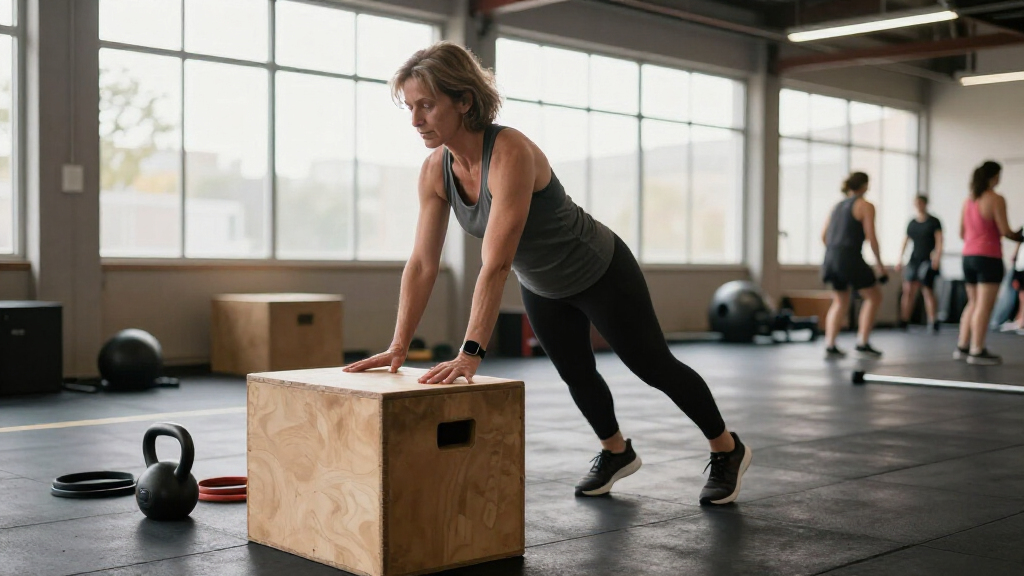
Her four-movement routine consists of a burpee, squat jump, squat to upright row and plank dumbbell pull-through. The first three train fast force production through whole-body or lower-body movements; the plank pull-through instead challenges the person to stabilize the torso as weight shifts between arms. Hansen suggests two or three sets of five to six repetitions per exercise, resting 60 to 90 seconds between sets. For the pull-through, the source specifies five to six repetitions on each side.
The movements can be scaled: burpees can be done by stepping rather than jumping, squat jumps can be replaced by rising onto the toes, and the plank pull-through can be performed from the knees. Hansen advises prioritizing crisp, controlled repetitions over exhaustion, saying power declines as fatigue builds. The report does not provide trial results or a claim that this specific routine is appropriate for every person.
Why Quick Force Matters in Daily Movement
Power has practical relevance because some everyday situations call for a quick response, not just the ability to lift or carry something slowly. Hansen points to catching oneself after a trip or moving rapidly to regain balance as examples. That makes the distinction between strength and power useful for readers choosing how to think about exercise: strength training can build force capacity, while power work practices applying force quickly.
The report’s advice is best read as trainer guidance, rather than proof of a health outcome. It does not establish that training power prevents falls, preserves independence, or increases longevity. It does, however, offer an accessible way to think about movement practice and gives lower-impact options for people who are not ready to jump. Anyone with pain, a balance concern, a chronic condition or limited exercise experience should seek suitable professional guidance before trying a new routine.
As an affiliate, we earn on qualifying purchases.
Strength Training Is Not the Whole Picture
The Fit&Well article places power alongside the more familiar discussion of strength training in midlife. Hansen’s point is that being strong and being able to use strength quickly are related but distinct abilities. A controlled squat, for example, can be performed slowly; a jump asks the body to produce force rapidly and then manage the landing.
The source presents a coach’s exercise suggestions, not a clinical guideline or a report on a newly published experiment. It gives no study population, measured outcomes, or comparison group for the four-move sequence. Its central contribution is a practical workout framework: familiar movements, adjustable impact and rest periods intended to preserve movement quality.
“That means being able to use your strength at speed—a skill that matters when you need to catch yourself after a trip or move quickly to regain your balance.”
— Kylie Hansen
As an affiliate, we earn on qualifying purchases.
Evidence and Individual Suitability
The supplied report does not identify a study showing how much power declines in midlife women, how quickly that change occurs, or whether this particular workout improves long-term health. Its references to longevity and age-related muscle-fiber changes should not be read as proof that the routine extends life or prevents injury. The report also does not specify how often to do the workout or how to progress it over time.
Individual suitability is another open question. Jumping and plank positions may not work for everyone, and the article does not offer personalized screening. People with existing health conditions, pain, balance difficulties or concerns about impact should ask a qualified health or fitness professional about appropriate modifications before starting.
As an affiliate, we earn on qualifying purchases.
How to Apply the Workout Safely
Readers following Hansen’s outline can begin with the step-back burpee, toe-rise squat and knee-supported plank pull-through options, using a range of motion they can control. The source recommends two to three sets, five to six repetitions and 60 to 90 seconds of rest between sets. It does not set a weekly schedule, so it should not be treated as a complete personalized training plan.
During each set, the practical test is whether the movement remains controlled and purposeful. If fatigue makes speed or form deteriorate, Hansen’s advice is to rest rather than keep adding repetitions. Further guidance on frequency, progression and suitability would require an individualized plan or additional evidence beyond what the Fit&Well report provides.
resistance bands for power training
As an affiliate, we earn on qualifying purchases.
As an affiliate, we earn on qualifying purchases.
Key Questions
What does muscular power mean?
Muscular power is the ability to produce force quickly. Hansen describes it as using strength at speed, such as when moving quickly to recover balance.
Which exercises does the report recommend?
The routine includes a burpee, squat jump, squat to upright row and plank dumbbell pull-through. Hansen offers modifications, including stepping instead of jumping and doing the pull-through from the knees.
How many sets and repetitions are suggested?
Hansen suggests two or three sets of five to six repetitions per exercise, with 60 to 90 seconds of rest between sets. The pull-through is listed as five to six repetitions per side.
Does this workout prevent falls or increase longevity?
The report does not establish that it prevents falls or extends lifespan. It presents Hansen’s view that power is relevant to quick movements and offers exercises for practicing it.
What if jumping or planks are not suitable?
The report suggests lower-impact options, such as stepping through a burpee, rising onto the toes instead of jumping, or performing the plank pull-through from the knees. People with health conditions, pain or balance concerns should seek professional advice about safe alternatives.
Source: rss
Fall Picks
fall essentials
As an affiliate, we earn on qualifying purchases.