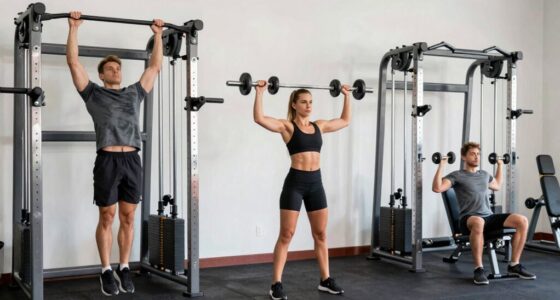
To add accessory work properly, focus on exercises that target your weaknesses and support your main lifts without overloading your schedule. Keep volume moderate—around 8-15 total sets per session—and avoid high reps or excessive load that can cause fatigue. Prioritize quality over quantity and gradually increase intensity. Proper form and recovery are essential. Continued effort on these principles will help you optimize your program and achieve better results efficiently.
Key Takeaways
- Prioritize quality over quantity by selecting effective, targeted accessory exercises that address specific weaknesses.
- Keep total accessory volume within 8-15 sets per session to prevent overtraining and fatigue.
- Use moderate intensity (70-85% 1RM) and focus on proper form to maximize benefits safely.
- Gradually increase volume and complexity, monitoring recovery and adjusting as needed.
- Align accessory work with your main goals, ensuring it supports rather than detracts from primary lifts.
Are you wondering how to incorporate accessory work into your training routine effectively? The key lies in balancing volume and selecting exercises carefully. You don’t want to overdo it, but you also don’t want to neglect the smaller muscles that support your main lifts. The goal is to enhance your overall performance without risking overtraining or injury. Start by evaluating your current training load and identify areas where you could use extra development. This helps you determine how much accessory work is appropriate and which muscles need more attention.
Balancing volume means you should avoid piling on too many sets and reps, especially if you’re already pushing hard on your primary lifts. Instead, focus on quality over quantity. For most people, two to three accessory exercises per workout, with a total of 8-15 sets, suffice to promote growth and strength without overwhelming the body. Keep the intensity moderate—around 70-85% of your one-rep max—and prioritize proper form. This way, you prevent fatigue from creeping in too quickly and ensure your main lifts stay fresh and effective.
Limit accessory exercises to 2-3 per session with 8-15 total sets for balanced progress.
Selecting exercises is another critical step. It’s tempting to add a wide array of movements, but more isn’t always better. Instead, choose exercises that target your weak points or muscles that support your main lifts. For example, if you’re looking to improve your bench press, incorporate tricep extensions, shoulder presses, or chest flyes. If deadlifts are your focus, consider hamstring curls, glute bridges, and core work. Select movements that complement your primary training and address specific deficiencies. Keep your accessory exercises simple and effective—compound movements or isolation exercises that directly influence your weak points tend to deliver the best results. Additionally, understanding training volume helps you optimize your routine without overloading your system.
When adding accessory work, always start with a manageable volume and gradually increase as your body adapts. Be mindful of how your muscles respond and avoid sacrificing recovery time. Rest days are just as important as workout days, so don’t neglect them. Incorporate variety over time to prevent plateaus, but don’t overhaul your routine too frequently. Stick with a plan long enough to see progress, then adjust based on your evolving needs. Remember, the goal is to support your main lifts and overall strength development without doing too much. By balancing volume carefully and selecting exercises thoughtfully, you can integrate accessory work seamlessly into your training, making it an effective tool rather than a source of fatigue.

TYZDMY Adjustable Dumbbells Set of 2,Free Weights Dumbbells Set,Adjustable Dumbbell Set,52.5 lbs pair 105 lbs,15 in 1,for Men/Women Gym Equipment for Home Strength Training Equipment
【15 in1 Adjustable Dumbbells】You will receive a pair of 52.5 lb dumbbells, each adjustable in 15 different weights:…
As an affiliate, we earn on qualifying purchases.
As an affiliate, we earn on qualifying purchases.
Frequently Asked Questions
How Do I Know if I’m Doing Too Much Accessory Work?
If you notice overtraining signs like persistent fatigue, soreness, or declining performance, you might be doing too much accessory work. Keep an eye on your accessory volume—if you’re adding too many sets or exercises daily, it can overload your muscles. To avoid this, gradually increase your accessory work and listen to your body. Rest and recovery are essential; don’t push through pain or excessive fatigue.
What Are the Best Accessories for Beginners?
As a beginner, start with basic accessory variations like dumbbell curls, tricep extensions, and bodyweight exercises such as planks. Focus on manageable training volume, doing 2-3 sets per exercise and gradually increasing as you build strength. Keep your workouts balanced, avoid overloading, and listen to your body. These accessories help target muscles effectively without overwhelming you, setting a solid foundation for progress.
Should Accessory Work Be Done on Rest Days?
You can do accessory work on rest days, but it’s like walking a tightrope—you don’t want to overdo it. Focus on recovery strategies and listen to your body to avoid burnout. Incorporating light accessory exercises on rest days can boost your workout frequency without draining your energy. Just make sure you’re not sacrificing recovery, or you’ll risk setbacks instead of progress. Balance is key to long-term gains.
How Can I Prevent Injury From Extra Accessory Exercises?
To prevent injury from extra accessory exercises, you should monitor overtraining risks and prioritize proper recovery. Gradually increase the volume and intensity of your accessory work, listen to your body’s signals, and avoid pushing through pain. Incorporate rest days and active recovery to allow muscles to repair. Proper warm-up and stretching also reduce injury risk, ensuring your training remains safe and effective.
How Do I Balance Accessory Work With My Main Training?
You should balance accessory work with your main training by using progression strategies and exercise variation. Start with lighter weights and gradually increase intensity to prevent overtraining or injury. Mix up exercises to target different muscles and avoid plateaus. Prioritize quality over quantity, and listen to your body’s signals. Incorporate rest days and adjust your accessory volume based on how your main lifts progress, ensuring a balanced, effective routine.
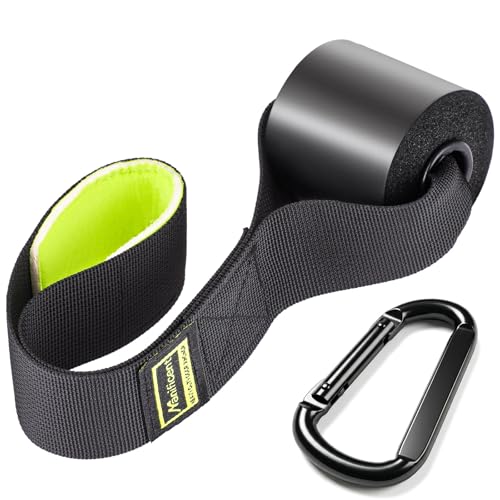
Manificent Door Anchor for Resistance Bands, Heavy Duty Padded Door Anchor System Door Hook, Must-Have Workout Exercise Bands Attachment Compatible for Loop Bands, Resistance Tube TRX, Yoga Strap
–BETTER MATERIAL–: Constructed from premium 600D Oxford fabric, our Door Anchor for Resistance Bands is built to last….
As an affiliate, we earn on qualifying purchases.
As an affiliate, we earn on qualifying purchases.
Conclusion
Now that you know how to add accessory work the right way, aren’t you excited to see your progress skyrocket? Remember, it’s all about balance—too much can hold you back, but just enough will boost your gains. Stay mindful of your body’s signals and prioritize quality over quantity. Ready to access your full potential without burnout? Keep these tips in mind, and watch your strength and endurance grow—because smart training always wins.
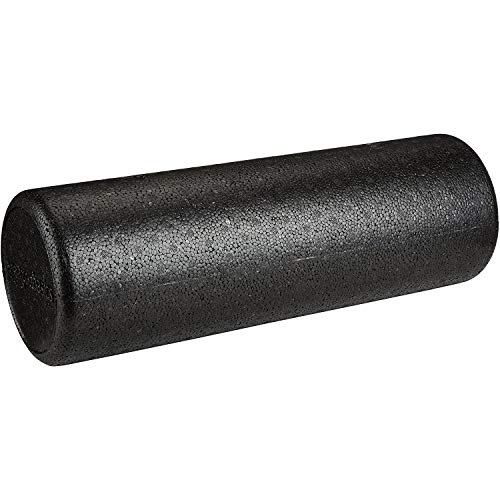
Amazon Basics High-Density Foam Roller for Exercise and Recovery, 18 Inches, Black
High-density foam roller in Black
As an affiliate, we earn on qualifying purchases.
As an affiliate, we earn on qualifying purchases.
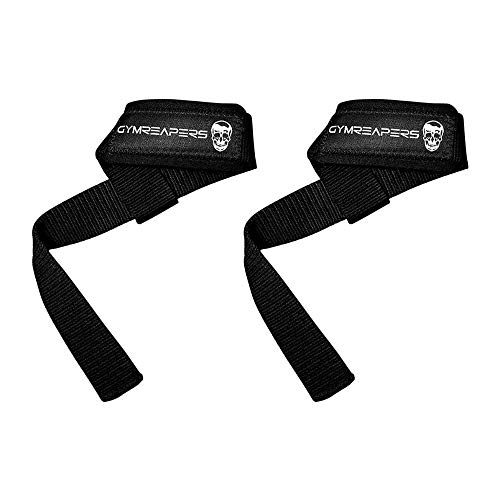
Gymreapers Lifting Wrist Straps for Weightlifting, Bodybuilding, Powerlifting, Strength Training, & Deadlifts – Padded Neoprene with 18" Cotton (Black)
𝗚𝗬𝗠𝗥𝗘𝗔𝗣𝗘𝗥𝗦 𝗟𝗜𝗙𝗧𝗜𝗡𝗚 𝗦𝗧𝗥𝗔𝗣𝗦 – Built for lifters who refuse to let grip fatigue limit performance. These classic cotton…
As an affiliate, we earn on qualifying purchases.
As an affiliate, we earn on qualifying purchases.