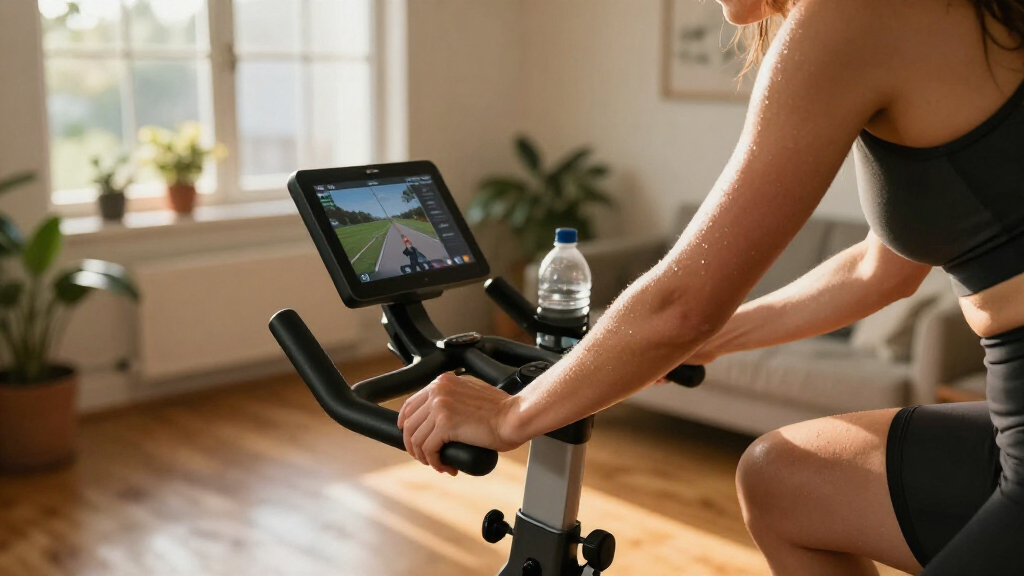
For most riders, I’d start with the Sunny Health & Fitness Nova Smart Indoor Cycling Bike as the best overall pick for a connected indoor-cycling setup. The MERACH S36L3 stands out if a large rotatable screen is a priority, while the Sunny Health & Fitness Smart Foldable X-Bike suits homes where storage space matters more than a traditional cycling position. The main tradeoff is between interactive features and simplicity: a built-in screen can make workouts easier to follow, while app-compatible bikes may rely on your own device and offer a more flexible setup. Fit, resistance feel, footprint, and recurring app costs also differ across this lineup. Continue reading for the full breakdown and help matching a bike to your space and training style.

Get workout gear delivered free with Prime
- Fast, free delivery on millions of items
- Prime Video, Amazon Music and more included
- Member-only deals all year
Complete the kit


Key Takeaways
- The Sunny Health & Fitness Nova is my best overall pick for balancing smart-bike positioning with a dedicated indoor-cycling format; buyers who want a large integrated display should compare it with the MERACH S36L3.
- Display size changes the workout experience, not just the look. The MERACH S36L3 and MERACH model with a 15.6-inch display appeal to riders who want a more screen-centered setup, while app-compatible bikes can suit people who prefer using a phone or tablet.
- Connectivity does not automatically mean a complete training system. Check what the bike tracks, which apps it supports, and whether subscriptions or a personal device are needed before choosing by the word “smart.”
- The Sunny foldable X-Bike solves a different problem from spin-style bikes. Its compact folding form and arm exerciser favor convenient, space-conscious movement, not the same riding position or workout feel as a conventional indoor cycling bike.
- Fit and riding posture separate otherwise similar options. Adjustable seats and handlebars matter for frequent use, while the 3G Cardio Elite RB’s recumbent design serves riders seeking back support rather than a forward-leaning cycling position.
| YOSUDA Indoor Exercise Bike with App Connectivity, Orange |  | Best for Simple, Adjustable Training | Flywheel: 25 lb | Resistance: Friction; 100 levels | Drive: Belt | VIEW LATEST PRICE | See Our Full Breakdown |
| MERACH Magnetic Indoor Exercise Bike with 15.6-Inch Display |  | Best Built-In Screen Experience | Display: 15.6-inch HD (1920 × 1080) | Display adjustment: Swivels 90° and tilts 60° | Resistance: Magnetic; 8 levels | VIEW LATEST PRICE | See Our Full Breakdown |
| Sunny Health & Fitness Smart Foldable Magnetic X-Bike with Arm Exerciser |  | Best for Compact Full-Body Workouts | Type: Foldable indoor exercise bike with arm exerciser | Resistance: 14-level belt-driven magnetic | Connectivity: Bluetooth; SunnyFit app | VIEW LATEST PRICE | See Our Full Breakdown |
| Sunny Health & Fitness Magnetic Belt-Drive Indoor Cycling Bike |  | Best for a Heavier-Flywheel Ride | Flywheel: 44 lb | Resistance: Magnetic, micro-adjustable | Drive: Belt | VIEW LATEST PRICE | See Our Full Breakdown |
| Sunny Health & Fitness Nova Smart Indoor Cycling Bike |  | Best for Guided App Workouts | Flywheel: 18 lb | Resistance: Magnetic; 35 levels | Drive: Belt | VIEW LATEST PRICE | See Our Full Breakdown |
| SLUNSE FITNESS EB1 Indoor Exercise Bike with Adjustable Magnetic Resistance |  | Best for Fine-Tuned Resistance | Resistance: 100-level micro-adjustable magnetic | Flywheel: 35 lb | Drive system: Belt drive | VIEW LATEST PRICE | See Our Full Breakdown |
| MERACH S36L3 Magnetic Exercise Bike with 21.5-Inch Rotatable HD Display |  | Best Built-In Screen Experience | Resistance: 16 magnetic levels; automatic or manual control | Display: 21.5-inch HD; swivels 180° and tilts 180° | Drive system: Belt | VIEW LATEST PRICE | See Our Full Breakdown |
| Lacuffy S1-Pro Indoor Cycling Bike with 32-Level Magnetic Resistance |  | Best for Compact, App-Tracked Workouts | Resistance: 32 magnetic levels | Drive system: Belt | App connectivity: Bluetooth; PitPat app | VIEW LATEST PRICE | See Our Full Breakdown |
| CURSOR Fitness Indoor Exercise Bike with Adjustable Seat and Handlebars |  | Best for Simple, Quick Setup | Resistance mechanism: Friction; 100 resistance levels | Drive system: Belt | Frame and capacity: Alloy steel; 300 lb | VIEW LATEST PRICE | See Our Full Breakdown |
| YESOUL Magnetic Stationary Exercise Bike for Home |  | Best for App Variety and High Capacity | Resistance: 100 manual magnetic levels | Connectivity and apps: Bluetooth; YESOUL FITNESS, Zwift, and Kinomap | Tracked metrics: Distance, time, calories, speed, heart rate, odometer, and cadence | VIEW LATEST PRICE | See Our Full Breakdown |
| Pooboo Indoor Exercise Bike with Magnetic Resistance and App Compatibility |  | Best for Fine Resistance Control | Resistance: 100-level magnetic | Drive: Belt drive | Noise level: Below 25 dB | VIEW LATEST PRICE | See Our Full Breakdown |
| Sunny Health & Fitness Smart Indoor Cycling Exercise Bike |  | Best for App-Guided Spin Workouts | Model: SF-B901SMART | Flywheel: 40 lb | Resistance: Micro-adjustable friction with dual felt pads | VIEW LATEST PRICE | See Our Full Breakdown |
| 3G Cardio Elite RB Recumbent Exercise Bike |  | Best for Seated Comfort and Support | Bike type: Recumbent | Dimensions: 49 × 27 × 43 in | Weight: 115 lb | VIEW LATEST PRICE | See Our Full Breakdown |
| JOROTO X2PRO Magnetic Exercise Bike |  | Best for Quiet, Broad-Range Fit | Flywheel: 40 lb | Resistance: Adjustable magnetic | Noise level: Below 20 dB | VIEW LATEST PRICE | See Our Full Breakdown |
| smart exercise bike | Resistance | Connectivity | Rider height range | Maximum user weight |
|---|---|---|---|---|
| YOSUDA Indoor Exercise Bike wi | Friction; 100 levels | Bluetooth app support | 4 ft 8 in to 6 ft | 300 lb |
| MERACH Magnetic Indoor Exercis | Magnetic; 8 levels | MERACH app, Google Fit, Apple Health, Kinomap, and Zwift | 4 ft 8 in to 6 ft 2 in | 300 lb |
| Sunny Health & Fitness Smart F | 14-level belt-driven magnetic | Bluetooth; SunnyFit app | — | 300 lb |
| Sunny Health & Fitness Magneti | Magnetic, micro-adjustable | Bluetooth; SunnyFit | — | 300 lb |
| Sunny Health & Fitness Nova Sm | Magnetic; 35 levels | — | 5 ft–6 ft 4 in | 120 kg |
| SLUNSE FITNESS EB1 Indoor Exer | 100-level micro-adjustable magnetic | — | 4’8" to 6’1" | — |
| MERACH S36L3 Magnetic Exercise | 16 magnetic levels; automatic or manual control | — | — | 330 lb |
| Lacuffy S1-Pro Indoor Cycling | 32 magnetic levels | — | 5’1" to 5’11" | — |
| CURSOR Fitness Indoor Exercise | — | — | 4’8" to 6’2" | — |
| YESOUL Magnetic Stationary Exe | 100 manual magnetic levels | — | — | — |
| Pooboo Indoor Exercise Bike wi | 100-level magnetic | Bluetooth; compatible with pooboo, FantomFite, Zwift, and Kinomap | — | — |
| Sunny Health & Fitness Smart I | Micro-adjustable friction with dual felt pads | — | — | — |
| 3G Cardio Elite RB Recumbent E | Magnetic; 16 levels | FTMS Bluetooth and third-party fitness app connectivity | — | 350 lb |
| JOROTO X2PRO Magnetic Exercise | Adjustable magnetic | JOROTO app, Zwift, and Kinomap | 4’9"–6’4" | — |
More Details on Our Top Picks
YOSUDA Indoor Exercise Bike with App Connectivity, Orange
The YOSUDA Indoor Exercise Bike is a straightforward choice for riders who want app connectivity without giving up a simple bike setup. Its four-way seat and two-way handlebar adjustment give more flexibility to fit different riding positions than the fixed-fit feel some compact bikes can impose. The belt drive is designed for quiet operation, while Bluetooth support and a tablet holder make it easy to follow a workout on a personal device. Compared with the Sunny Health & Fitness Nova, YOSUDA offers a heavier 25 lb flywheel, but uses friction resistance rather than magnetic resistance. That means this pick favors adjustability and a solid basic ride over the Nova’s magnetic system and guided app features. Assembly is required, and the friction mechanism is a less appealing match for buyers seeking magnetic resistance.
Pros:- Four-way seat and two-way handlebar adjustments help riders find a comfortable fit.
- Belt drive is designed for a smooth, quiet ride.
- Bluetooth app support, LCD, and tablet holder support connected workouts.
- Adjustable cage pedals and emergency-stop resistance bar add riding control.
Cons:- Friction resistance may not suit buyers who specifically want a magnetic system.
- Assembly is required before riding.
Best for: Riders who want an adjustable home bike with Bluetooth app support and a tablet holder, particularly those within the listed 4 ft 8 in to 6 ft height range.
Not ideal for: Buyers set on magnetic resistance or a bike with a built-in large display; this model uses friction resistance and a basic LCD.
- Flywheel:25 lb
- Resistance:Friction; 100 levels
- Drive:Belt
- Connectivity:Bluetooth app support
- Display:LCD
- Rider height range:4 ft 8 in to 6 ft
- Maximum user weight:300 lb
- Dimensions:29.9 × 7.47 × 38.6 in (D × W × H)
Our verdict“Choose the YOSUDA if fit adjustment and basic app-connected riding matter more to you than magnetic resistance or a built-in entertainment screen.”
MERACH Magnetic Indoor Exercise Bike with 15.6-Inch Display
The MERACH Magnetic Indoor Exercise Bike is the clearest pick here for riders who want a substantial screen built into the bike. Its 15.6-inch HD display swivels and tilts, so it can support phone projection and workout viewing from different positions. Magnetic resistance and a belt drive make this a more screen-centered alternative to the YOSUDA, which relies on a basic LCD and a separate tablet. The MERACH also offers connections to several fitness apps and useful storage, including a dumbbell rack. The tradeoff is compatibility: the supplied product information lists it as incompatible with iPhone 17 series and Google phones, which may rule it out for some households. Its eight resistance levels also offer less listed granularity than the YOSUDA’s 100 friction levels.
Pros:- 15.6-inch HD display swivels 90° and tilts 60° for flexible viewing.
- Magnetic resistance and a belt drive support a quieter workout setup.
- Connects with MERACH app, Google Fit, Apple Health, Kinomap, and Zwift.
- Includes transport wheels, bottle holder, dumbbell rack, and cage pedals.
Cons:- Listed as incompatible with iPhone 17 series and Google phones.
- Eight resistance levels provide fewer listed steps than the YOSUDA’s 100-level system.
- Assembly is required.
Best for: Home cyclists who want a large adjustable display, phone projection, and app connections, and whose devices are compatible with the bike.
Not ideal for: Owners of iPhone 17 series or Google phones, and riders who want a wide range of listed resistance steps.
- Display:15.6-inch HD (1920 × 1080)
- Display adjustment:Swivels 90° and tilts 60°
- Resistance:Magnetic; 8 levels
- Drive:Belt
- Connectivity:MERACH app, Google Fit, Apple Health, Kinomap, and Zwift
- Rider height range:4 ft 8 in to 6 ft 2 in
- Maximum user weight:300 lb
- Dimensions:40 × 19 × 44 in
Our verdict“Pick the MERACH if a movable built-in screen is your priority and your phone is not among the listed incompatible devices.”
Sunny Health & Fitness Smart Foldable Magnetic X-Bike with Arm Exerciser
The Sunny Health & Fitness Smart Foldable Magnetic X-Bike earns its place by combining cycling with an arm exerciser and a folding frame. That makes it a more space-conscious, mixed-workout option than the Sunny Health & Fitness Magnetic Belt-Drive Indoor Cycling Bike, which is built around a conventional cycling position and a heavier 44 lb flywheel. The X-Bike’s 14 levels of magnetic resistance, Bluetooth connection, and SunnyFit app support give riders ways to vary and track sessions without adding a large screen. Its transport wheels and foldable design are especially useful when a bike needs to move out of the way after exercise. The main fit caveat is the 28.7–33.9 inch inseam range, which is narrower than some other bikes in this group; it also requires assembly.
Pros:- Folding design and transport wheels make it easier to store between workouts.
- Arm exerciser adds upper-body work alongside low-impact cycling.
- Fourteen magnetic resistance levels support workout variation.
- Bluetooth and SunnyFit app connection pair with a monitor tracking several workout metrics.
Cons:- Listed inseam range may not fit riders with shorter or longer legs.
- Assembly is required.
Best for: Apartment dwellers or multi-use-room exercisers who want a foldable bike that adds arm work to low-impact cycling.
Not ideal for: Riders outside the listed 28.7–33.9 inch inseam range or cyclists seeking a conventional studio-bike setup with a heavier flywheel.
- Type:Foldable indoor exercise bike with arm exerciser
- Resistance:14-level belt-driven magnetic
- Connectivity:Bluetooth; SunnyFit app
- Monitor metrics:Time, speed, distance, calories, odometer, and RPM
- Inseam range:28.7–33.9 in
- Maximum user weight:300 lb
- Features:Adjustable cushioned seat, device holder, and transport wheels
- Assembly time:About 30 minutes
Our verdict“Choose this X-Bike if folding storage and combined arm-and-leg workouts matter more than a traditional cycling-bike feel.”
Sunny Health & Fitness Magnetic Belt-Drive Indoor Cycling Bike
For riders who value a more substantial cycling setup over folding storage or a large display, the Sunny Health & Fitness Magnetic Belt-Drive Indoor Cycling Bike is the strongest fit in this batch. Its 44 lb flywheel is heavier than the 25 lb flywheel on the YOSUDA, while magnetic, micro-adjustable resistance gives this model a different resistance system from YOSUDA’s friction design. Four-way seat and handlebar adjustments help tune the riding position, and Bluetooth links the bike to SunnyFit for app-based tracking. Unlike the MERACH, it does not have a built-in large screen, so riders will need a compatible mobile device for app features and their own screen for entertainment. Its listed 29–40 inch inseam range may also exclude riders outside that span.
Pros:- 44 lb flywheel offers a heavier setup than the YOSUDA’s 25 lb flywheel.
- Magnetic micro-adjustable resistance paired with a belt drive.
- Four-way seat and handlebar adjustment support a more tailored riding position.
- Bluetooth, SunnyFit, and an onboard monitor support workout tracking.
Cons:- A compatible mobile device is needed for Bluetooth app features.
- The 29–40 inch inseam range may not fit all riders.
- No large built-in display is listed.
Best for: Cyclists who want a conventional indoor-bike setup, a heavier flywheel, magnetic resistance, and app-based tracking through a personal device.
Not ideal for: Riders who need a built-in workout display, a folding bike, or a fit beyond the listed 29–40 inch inseam range.
- Flywheel:44 lb
- Resistance:Magnetic, micro-adjustable
- Drive:Belt
- Seat and handlebar adjustment:4-way adjustable
- Inseam range:29–40 in
- Connectivity:Bluetooth; SunnyFit
- Maximum user weight:300 lb
- Additional features:Tablet holder, bottle holder, hand pulse sensors, floor levelers, and transport wheels
Our verdict“Choose this Sunny bike if you want a heavier-flywheel cycling setup with magnetic resistance and do not need a built-in screen.”
Sunny Health & Fitness Nova Smart Indoor Cycling Bike
The Sunny Health & Fitness Nova is the app-led choice for riders who want guided workouts, scenic rides, and fitness plans without relying on a large built-in screen. Its SunnyFit connectivity adds more structured workout content than the YOSUDA’s basic Bluetooth app support, while the Nova’s magnetic resistance and belt drive differ from YOSUDA’s friction system. The Nova has 35 resistance levels, giving riders a range of adjustments for home sessions, and transport wheels help when it needs to be moved. Its 18 lb flywheel is described as entry-level, though, so riders who prioritize a heavier flywheel may prefer the 44 lb Sunny Health & Fitness Magnetic Belt-Drive Indoor Cycling Bike. Fit is also more limited by the listed 28–35.8 inch inseam range.
Pros:- SunnyFit includes guided workouts, scenic rides, fitness plans, and progress tracking.
- Magnetic resistance with 35 levels supports varied workout adjustments.
- Belt drive is designed for smooth, quiet home riding.
- Transport wheels support easier movement after workouts.
Cons:- The 18 lb flywheel is described as entry-level and is much lighter than the 44 lb flywheel on the other Sunny bike in this batch.
- Listed rider fit is limited to 5 ft–6 ft 4 in and 28–35.8 in inseam.
- A separate device is needed to view app content; no built-in display is listed.
Best for: Newer home cyclists who want guided and scenic app workouts, magnetic resistance, and a bike that can be moved around the room.
Not ideal for: Riders seeking a heavier-flywheel feel or anyone outside the listed 5 ft to 6 ft 4 in height and 28–35.8 inch inseam ranges.
- Flywheel:18 lb
- Resistance:Magnetic; 35 levels
- Drive:Belt
- App connectivity:SunnyFit
- Rider height range:5 ft–6 ft 4 in
- Inseam range:28–35.8 in
- Maximum user weight:120 kg
- Dimensions:42.5 × 22.4 × 47.6 in (D × W × H)
Our verdict“Pick the Nova if guided SunnyFit content matters more to you than a heavier flywheel or a built-in workout screen.”
SLUNSE FITNESS EB1 Indoor Exercise Bike with Adjustable Magnetic Resistance
The SLUNSE FITNESS EB1 suits riders who want precise manual control without relying on a large built-in screen. Its 100-level magnetic resistance offers finer adjustment than the MERACH S36L3’s 16 levels, while Zwift and Kinomap connectivity add guided or virtual rides through a separate device. A 35-pound flywheel and belt drive are designed for smooth, quiet pedaling, and four-way seat adjustment helps more riders find a workable position. The LCD keeps basic stats visible, but it is not a substitute for the MERACH’s rotatable HD display. I’d choose the EB1 for app flexibility and incremental resistance changes; skip it if you want an all-in-one screen experience or a longer warranty, since coverage is one year.
Pros:- 100 resistance levels allow small adjustments to workout intensity.
- Zwift and Kinomap compatibility supports app-based training.
- Four-way seat adjustment and two-way handlebar adjustment fit a range of riders.
- Belt drive, transport wheels, and 80% pre-assembly simplify quieter riding and setup.
Cons:- The LCD only displays basic workout metrics, unlike the MERACH S36L3’s large HD screen.
- A rider must provide a separate device for app visuals.
- The stated warranty is one year.
Best for: Riders who want highly adjustable magnetic resistance and plan to use Zwift or Kinomap on their own tablet or phone.
Not ideal for: Buyers who want an integrated HD workout screen or more than one year of stated warranty coverage.
- Resistance:100-level micro-adjustable magnetic
- Flywheel:35 lb
- Drive system:Belt drive
- Maximum capacity:350 lb
- Rider height range:4’8″ to 6’1″
- Adjustments:4-way seat; 2-way handlebars
- Monitor and apps:LCD for time, speed, distance, calories, and odometer; Zwift and Kinomap compatible
- Assembly and warranty:80% pre-assembled; approximately 20–25 minutes setup; 1-year warranty
Our verdict“Choose the EB1 for finely stepped magnetic resistance and app compatibility, not for an integrated entertainment display.”
MERACH S36L3 Magnetic Exercise Bike with 21.5-Inch Rotatable HD Display
The MERACH S36L3 is the clearest choice here for riders who want a large screen attached to the bike rather than a phone or tablet holder. Its 21.5-inch rotatable HD display swivels and tilts, making it more useful for off-bike viewing than the basic LCD on the SLUNSE EB1. The MERACH app provides workout tracking, and resistance can be adjusted automatically or manually across 16 magnetic levels. That’s a more screen-centered setup, but not the finer resistance control offered by the EB1’s 100 levels. The wide stated fit range, from 4’8″ to 6’4″, also suits shared households. I’d pass if you use a Google phone for screen mirroring: that feature is currently unsupported. It also needs a corded power connection, which limits placement.
Pros:- 21.5-inch display swivels and tilts for varied viewing positions.
- Automatic and manual control provide two ways to manage 16 magnetic resistance levels.
- Stated rider height range of 4’8″ to 6’4″ suits many shared-use households.
- MERACH app syncs with Google Fit and Apple Health.
Cons:- Screen mirroring is not currently compatible with Google phones.
- Corded electric power restricts where the bike can be placed.
- Its 16 resistance levels offer less granular adjustment than the SLUNSE EB1.
Best for: Households that want an integrated, movable display and a bike that accommodates riders of notably different heights.
Not ideal for: Google-phone users who want screen mirroring, or anyone who needs to place a bike far from a power outlet.
- Resistance:16 magnetic levels; automatic or manual control
- Display:21.5-inch HD; swivels 180° and tilts 180°
- Drive system:Belt
- Maximum user weight:330 lb
- User height range:4’8″ to 6’4″
- Adjustments:4-way seat; 2-way handlebars
- Noise and power:Under 25 dB; corded electric
- Dimensions and weight:43.2 x 18.9 x 50.8 in (D x W x H); 66 lb
Our verdict“Pick the S36L3 if an integrated rotatable screen matters more than fine-grained resistance control or flexible placement.”
Lacuffy S1-Pro Indoor Cycling Bike with 32-Level Magnetic Resistance
The Lacuffy S1-Pro is a straightforward app-connected pick for riders who want more resistance steps than a basic entry-level setup, without paying for an integrated display. Its 32 magnetic levels give finer workout adjustments than the MERACH S36L3’s 16, though it lacks that bike’s large rotatable screen and automatic resistance control. Bluetooth connects the S1-Pro to PitPat for tracking speed, RPM, distance, and calories; you’ll need your own phone or tablet for viewing. Its listed height range of 5’1″ to 5’11” is narrower than the SLUNSE EB1’s, so it is less suitable for a household with unusually short or tall riders. At 43.1 pounds, it is relatively light, but buyers should still check whether its dimensions and fit suit their workout space and users.
Pros:- 32 magnetic resistance levels offer more adjustment steps than the MERACH S36L3’s 16.
- Bluetooth connection to PitPat tracks speed, RPM, distance, and calories.
- Belt drive is described as operating under 25 dB.
- Transport wheels help when moving the 43.1-pound bike.
Cons:- The stated rider height range is limited to 5’1″–5’11”.
- No integrated display is listed, so app tracking requires a separate device.
- The 300-pound maximum recommendation is lower than the SLUNSE EB1’s 350-pound capacity.
Best for: Riders between 5’1″ and 5’11” who want app-based workout tracking and adjustable magnetic resistance without a built-in screen.
Not ideal for: Shared households with riders outside its stated height range, or buyers who want an integrated display or automatic resistance.
- Resistance:32 magnetic levels
- Drive system:Belt
- App connectivity:Bluetooth; PitPat app
- Tracked metrics:Speed, RPM, distance, and calories
- Rider height range:5’1″ to 5’11”
- Maximum weight recommendation:300 lb
- Dimensions and weight:40.55 x 19.29 x 44.09 in; 43.1 lb
- Frame and fit:Alloy steel; adjustable padded seat; handlebars with 7 height settings
Our verdict“Choose the S1-Pro for app tracking and 32 resistance steps if its narrower rider fit matches your household.”
CURSOR Fitness Indoor Exercise Bike with Adjustable Seat and Handlebars
The CURSOR Fitness CBE is the practical pick for buyers who want a basic indoor bike that can be assembled quickly and adjusted for more than one rider. Most major components arrive pre-assembled, with setup listed at under 30 minutes; that’s a more direct route to riding than buying a bike that still needs extensive assembly. The seat and handlebars adjust across a stated rider height range of 4’8″ to 6’2″, comparable to the SLUNSE EB1’s broad fit. Its key compromise is friction resistance: unlike the EB1’s magnetic system, resistance comes from contact, so it may bring more wear and maintenance over time. The product lists 100 resistance levels and a belt drive designed for quiet riding, but it has no app connectivity or workout display specified. I’d choose it for straightforward setup, not connected training.
Pros:- Most major components are pre-assembled, with setup listed at under 30 minutes.
- Seat and handlebars adjust for riders from 4’8″ to 6’2″.
- Reinforced alloy-steel frame supports up to 300 lb.
- Belt drive is designed for quiet riding.
Cons:- Friction resistance differs from the magnetic systems on the SLUNSE EB1 and Lacuffy S1-Pro.
- No app connectivity or monitor is specified for tracking workouts.
- Battery power means it requires batteries.
Best for: Riders who want a quick-to-assemble, adjustable bike for straightforward indoor workouts and do not need app connectivity.
Not ideal for: Buyers who prioritize magnetic resistance, app-based workouts, or a screen with workout metrics.
- Resistance mechanism:Friction; 100 resistance levels
- Drive system:Belt
- Frame and capacity:Alloy steel; 300 lb
- Rider height range:4’8″ to 6’2″
- Seat adjustment:4-way; 7 vertical settings (32.2–39.1 in)
- Handlebar adjustment:5 vertical settings (36.2–46.85 in)
- Noise and power:Below 25 dB; battery powered
- Weight and assembly:39.7 lb; setup under 30 minutes
Our verdict“Pick the CBE for quick setup and broad adjustability if you are comfortable with friction resistance and a basic workout experience.”
YESOUL Magnetic Stationary Exercise Bike for Home
The YESOUL Magnetic Stationary Exercise Bike makes the most sense for riders who want to pair a bike with different training apps rather than rely on a single ecosystem. Bluetooth supports YESOUL FITNESS, Zwift, and Kinomap, while the listed metrics include cadence and heart rate alongside common ride stats. Its 100 manual magnetic resistance levels offer more adjustment steps than the MERACH S36L3’s 16, though the YESOUL has no integrated display listed and depends on a separate device for app viewing. Its 350-pound capacity matches the SLUNSE EB1, but the stated rider height range—approximately 5 to 6.1 feet—is narrower than the EB1’s. The 4 x 2 ft footprint helps set expectations for space, and 70% pre-assembly keeps setup manageable. The heart-rate armband is sold separately, so heart-rate tracking requires an extra purchase.
Pros:- Bluetooth supports YESOUL FITNESS, Zwift, and Kinomap.
- 100 manual magnetic levels allow fine adjustments to resistance.
- 350-pound capacity matches the SLUNSE EB1’s listed limit.
- Tracks cadence and several other workout metrics through compatible apps.
Cons:- Heart-rate armband is sold separately.
- Stated rider height range is narrower than the SLUNSE EB1’s.
- No integrated display is listed, so app workouts require a separate device.
Best for: Riders who want Bluetooth access to multiple training apps, detailed workout metrics, and a 350-pound capacity.
Not ideal for: Buyers outside the approximately 5-to-6.1-foot fit range, or anyone who expects included heart-rate monitoring hardware or a built-in screen.
- Resistance:100 manual magnetic levels
- Connectivity and apps:Bluetooth; YESOUL FITNESS, Zwift, and Kinomap
- Tracked metrics:Distance, time, calories, speed, heart rate, odometer, and cadence
- Weight capacity:350 lb
- Rider height:Approximately 5 to 6.1 ft
- Frame and footprint:Steel; 4 x 2 ft
- Assembly:70% pre-assembled; approximately 30 minutes
- Parts replacement:12 months
Our verdict“Choose YESOUL for app flexibility and high capacity if its rider fit works and you are willing to supply a screen and heart-rate armband.”
Pooboo Indoor Exercise Bike with Magnetic Resistance and App Compatibility
The Pooboo is a good fit for riders who want small, repeatable changes in effort rather than a handful of broad resistance steps. Its 100-level magnetic resistance offers finer adjustment than the 16 levels on the 3G Cardio Elite RB, while Bluetooth support for Zwift and Kinomap brings connected training without a built-in screen. The belt drive is specified below 25 dB, and the steel frame is rated for up to 350 pounds, making it a versatile option for shared home use. Four-way seat and two-way handlebar adjustment help dial in the fit. The tradeoff is that app workouts require a compatible device, and the product information gives differing rider-height ranges in separate sections. Buyers who want a reclined riding position should choose the 3G Cardio instead.
Pros:- 100 resistance levels allow precise changes in workout effort.
- Belt drive is specified below 25 dB for quieter home workouts.
- Four-way seat and two-way handlebar adjustment support a more tailored fit.
- Bluetooth works with Zwift and Kinomap, with Apple Health and Google Fit data sync.
Cons:- Conflicting stated rider-height ranges make fit harder to verify before purchase.
- Connected apps and the tablet holder require a separate compatible device.
- The LCD tracks basic workout data rather than providing a built-in class display.
Best for: Home riders who want fine-grained magnetic resistance, app workouts, and a bike that can accommodate multiple users.
Not ideal for: Buyers who need a clearly confirmed fit range or want a built-in workout screen rather than using their own phone or tablet.
- Resistance:100-level magnetic
- Drive:Belt drive
- Noise level:Below 25 dB
- Weight capacity:350 lbs
- Adjustments:4-way seat; 2-way handlebars
- Connectivity:Bluetooth; compatible with pooboo, FantomFite, Zwift, and Kinomap
- Display:LCD tracks time, distance, and calories
- Setup and portability:Mostly pre-assembled; transport wheels
Our verdict“Choose the Pooboo if precise magnetic resistance and app compatibility matter more than a built-in screen or an unambiguous height specification.”
Sunny Health & Fitness Smart Indoor Cycling Exercise Bike
For riders who want trainer-led sessions but do not need magnetic resistance, the Sunny Health & Fitness SF-B901SMART pairs SunnyFit app access with a 40-pound flywheel and micro-adjustable friction resistance. The app offers a more guided workout route than the basic display on the Pooboo, while the included dumbbell rack makes it easier to add light upper-body work during a ride. A push-down stop gives riders a direct way to halt the flywheel. The main compromise is the friction system: unlike the magnetic resistance on the JOROTO X2PRO, felt pads make contact with the flywheel, so this is a less attractive pick for buyers prioritizing magnetic resistance. Its 275-pound user limit is also lower than the 350-pound ratings of those two bikes.
Pros:- SunnyFit app access includes trainer-led workouts and scenic tours.
- 40-pound flywheel pairs with micro-adjustable resistance for controlled effort changes.
- Push-down stop provides a quick way to stop the flywheel.
- Four-way seat and two-way handlebar adjustment help tailor riding position.
Cons:- Friction resistance uses dual felt pads rather than magnetic resistance.
- 275-pound maximum user weight is lower than the Pooboo and JOROTO X2PRO.
- A 61.8-inch depth requires a dedicated floor area.
Best for: Riders who want app-led indoor cycling, a heavy flywheel, and a rack for keeping dumbbells close during workouts.
Not ideal for: Riders seeking magnetic resistance or a higher listed weight capacity; the friction mechanism and 275-pound limit may rule it out.
- Model:SF-B901SMART
- Flywheel:40 lb
- Resistance:Micro-adjustable friction with dual felt pads
- Drive:Belt drive
- User weight limit:275 lb
- Adjustments:4-way seat; 2-way handlebars
- Adjustable inseam height:29–41 in
- Dimensions:61.8 × 19.7 × 54.3 in (D × W × H)
- Included features:SunnyFit app connectivity and dumbbell rack
Our verdict“Pick the Sunny if guided SunnyFit workouts and its dumbbell rack appeal more than magnetic resistance or a higher weight limit.”
3G Cardio Elite RB Recumbent Exercise Bike
The 3G Cardio Elite RB serves a different buyer from the upright Pooboo and JOROTO X2PRO: its recumbent layout puts the rider in a supported position, with a cushioned seat and tilting mesh backrest. That makes it the strongest fit here for people who prefer back support and airflow over a conventional spin-bike posture. It also includes 12 preset programs, three heart-rate workouts, handheld sensors, and a wireless heart-rate strap. FTMS Bluetooth supports compatible apps without a required membership, though riders need to supply their own screen. Its 16 magnetic resistance levels offer less adjustment granularity than the Pooboo’s 100, and the bike requires a power connection. The 350-pound capacity and extensive seat adjustments add flexibility, but its 115-pound frame is not a lightweight choice.
Pros:- Cushioned seat and tilting mesh backrest support a more relaxed riding position.
- Includes 12 preset programs, three heart-rate workouts, and a wireless heart-rate strap.
- FTMS Bluetooth supports compatible third-party fitness apps without a required membership.
- 350-pound maximum user weight and extensive seat positioning options.
Cons:- Requires a corded power connection.
- App use requires a separate screen; no built-in display is listed.
- At 115 lb, it is heavier than a compact upright bike to reposition.
Best for: Riders who want a supported recumbent position, built-in workout programs, and heart-rate tracking without a required app membership.
Not ideal for: Spin-bike riders who want an upright posture, or buyers who need a cordless bike or a lighter frame to move around frequently.
- Bike type:Recumbent
- Dimensions:49 × 27 × 43 in
- Weight:115 lb
- Maximum user weight:350 lb
- Resistance:Magnetic; 16 levels
- Workout programs:12 preprogrammed and 3 heart-rate workouts
- Connectivity:FTMS Bluetooth and third-party fitness app connectivity
- Seat adjustment:5 tilt positions and 25 forward/back positions
- Included heart-rate equipment:Handheld sensors and wireless heart-rate strap
Our verdict“Choose the Elite RB for a supported recumbent ride and built-in programs, not for the upright cycling feel or finely stepped resistance of the Pooboo.”
JOROTO X2PRO Magnetic Exercise Bike
The JOROTO X2PRO is a straightforward match for riders who want a quiet magnetic bike with app options and a clearly stated height range. Its drive is specified below 20 dB, quieter on paper than the Pooboo’s below-25-dB figure, and its listed fit range of 4’9″ to 6’4″ gives buyers a defined reference point. Zwift and Kinomap compatibility add connected training, while the 40-pound flywheel and magnetic resistance cover warm-ups through harder sessions. Compared with the Sunny SF-B901SMART, it avoids friction pads and has a higher listed weight capacity, though the Sunny includes access to trainer-led SunnyFit workouts and a dumbbell rack. The JOROTO requires some assembly, and its 12-month warranty is a modest commitment for a home fitness machine.
Pros:- Magnetic resistance and a specified noise level below 20 dB suit quieter home workouts.
- Stated rider-height range of 4’9″ to 6’4″ helps buyers check fit.
- Compatible with JOROTO app, Zwift, and Kinomap for workout tracking and connected training.
- Includes a tablet holder, water bottle holder, cage pedals, and transport wheels.
Cons:- Requires assembly and adjustment after delivery.
- The stated warranty is 12 months.
- App workouts require a separate compatible screen or device.
Best for: Riders who want quiet magnetic resistance, a stated fit range spanning several heights, and compatibility with Zwift or Kinomap.
Not ideal for: Buyers who want an included workout screen, minimal setup, or a longer stated warranty.
- Flywheel:40 lb
- Resistance:Adjustable magnetic
- Noise level:Below 20 dB
- Weight capacity:350 lb
- Rider height range:4’9″–6’4″
- Connectivity:JOROTO app, Zwift, and Kinomap
- Adjustments:Four-way adjustable seat and handlebars
- Features:Tablet holder, water bottle holder, cage pedals, and transport wheels
- Assembly and warranty:80% pre-installed; stated assembly time under 30 minutes; 12-month warranty
Our verdict“Choose the JOROTO if quiet magnetic operation and a clearly stated rider-height range matter more than a built-in display or longer warranty.”
How We Picked
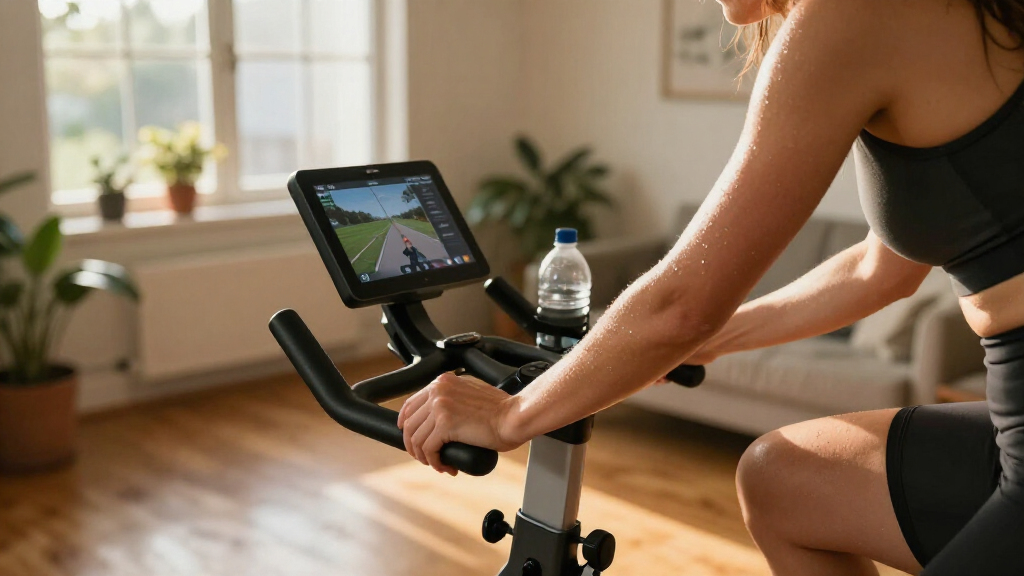
I compared these 14 bikes as home workout systems, not as a list of app features. My criteria included the kind of connectivity each model advertises, whether workouts depend on a separate phone or tablet, the resistance system, adjustment options, riding position, footprint, and the likely effort required to keep the bike useful over time. A screen can make guided sessions easier to follow, but it does not by itself prove that the bike offers better tracking, broader app support, or more effective training.
The ranking favors bikes that appear to balance connected features with practical everyday use and a clear fit for a particular rider. I place specialized picks lower when their form factor or feature set serves a narrower need, not because that design is inherently worse. Product names and listed features are the basis for these comparisons; buyers should confirm exact app compatibility, dimensions, user-fit ranges, and any subscription requirements with the seller before ordering.
Factors to Consider When Choosing Best Smart Exercise Bikes
Smart-bike listings can make very different setups sound interchangeable. I’d decide first how you want to ride and what you expect “smart” to do, then compare the bike’s fit, space needs, and ongoing requirements. These checks can prevent paying for a screen or connectivity feature that does not match your training habits.
Decide What “Smart” Needs to Do
Start by naming the job you want connectivity to perform: guided classes, workout tracking, resistance control, or simply a way to follow along on your own screen. These functions are not interchangeable, and a bike described as app-compatible may not offer the same experience as one with a built-in display. Check whether the model connects to the specific app you plan to use, and confirm whether it sends useful workout data back to that app. A common mistake is choosing by screen size before checking software support. If you already own a tablet and prefer a particular training service, an app-compatible bike may be the more flexible route. If you want fewer devices to set up, prioritize an integrated display and verify what content or services it requires.
Match Resistance to Your Training Habits
Resistance affects more than workout intensity: its range and adjustment method shape how easily you can move between steady rides and harder efforts. Magnetic resistance is common across this roundup, but that label alone does not tell you how many usable levels the bike has or how smoothly they change. Look for clear information about resistance adjustment and the type of sessions you expect to follow. A high number of levels can help with finer changes, though it does not guarantee that the bike will suit every training style. If several people will share the bike, easy adjustments can matter more than a long feature list. Avoid assuming that app connectivity automatically changes resistance for you; confirm whether resistance is manual or electronically controlled.
Check Fit Before Comparing Screens
A bike that does not fit your body can make even a well-designed workout system frustrating to use. Review the seat and handlebar adjustment directions, the stated user-height range, and how far the seat can move both vertically and horizontally. Many shoppers check only whether the seat height adjusts, overlooking reach to the handlebars and the riding posture that adjustment creates. That matters especially if more than one person will ride, since a quick seat-height change may not be enough to restore a comfortable position. Compare a conventional forward-leaning cycling bike with a recumbent model based on posture needs, not screen features. If the listing does not give enough fit detail, treat that as an unanswered question rather than assuming the frame will work.
Measure the Full Space the Bike Needs
Measure the bike’s operating footprint, the room needed to mount it, and the space for a nearby tablet or other accessories. Foldable designs can be helpful in shared rooms, but folding does not remove the need for a safe riding area or convenient storage access. Large displays may also affect placement, viewing angle, and clearance, so check the complete dimensions rather than the frame alone. A frequent mistake is measuring only the floor area where the bike stands and forgetting ceiling height, nearby furniture, or a route for moving the bike. If you plan to relocate it after every session, check for transport wheels and the bike’s stated weight. Choose a compact format only if its riding position also suits the workouts you intend to do.
Add Up Ongoing Costs and Device Needs
The purchase is only one part of a connected workout setup. Some riders will need a phone or tablet, a stable device mount, and possibly a separate subscription to access classes or performance features. Before choosing, find out which app functions are free, which require payment, and whether you can still use the bike without an account. Also check if the bike supports common devices you already own or depends on a narrower software ecosystem. A larger built-in display can reduce setup friction, but it may tie the workout experience to the included platform. For occasional riders, a simpler app-compatible model may be enough; regular class followers may value an integrated setup if the content and ongoing terms suit them.
Think About Noise, Upkeep, and Shared Use
Noise can determine whether a bike works in an apartment, a shared household, or a room used for other activities. Belt-drive and magnetic-resistance descriptions can help identify the intended mechanism, but they do not replace checking the manufacturer’s care guidance or reports about operating sound. Ask what routine checks are required, whether parts are user-serviceable, and how replacement components can be obtained. If several people will use the bike, prioritize durable adjustment points and controls that are straightforward to reset between riders. A bike used only occasionally may not need every connected feature, while frequent training makes maintenance access and dependable fit more consequential. Comparing these practical details can be more useful than paying extra for a feature that does not change how you ride.
Frequently Asked Questions
Does “app compatible” mean I can use any cycling app?
No. App compatibility varies by bike and can refer to basic Bluetooth connection, workout data sharing, or support for a specific service. Before buying, check the exact app names, the data each connection sends, and whether the app is available on your phone or tablet. Also confirm whether the bike works for a manual workout if you do not want to subscribe. If your training depends on one particular platform, verify compatibility with the manufacturer rather than relying on a broad listing phrase.
Should I choose a bike with a built-in display or use my own tablet?
A built-in display can reduce setup time and keep a workout interface in a fixed position, which may help if you plan to follow classes often. A personal tablet gives you more freedom to switch between apps, entertainment, and other uses, but you may need a secure mount and a device of suitable size. Neither option guarantees better tracking or training content. Check whether a built-in screen depends on a particular account or paid service, and whether an app-compatible bike reports the metrics you care about. Choose based on how you actually plan to use the screen, not on display size alone.
Can a foldable X-Bike replace a spin-style indoor cycling bike?
It can support convenient home exercise, but its compact frame and riding position serve a different purpose from a traditional indoor cycling bike. The Sunny foldable X-Bike is a better match for buyers who value storage and added arm movement than for riders focused on a familiar spin-class posture. Consider how much you plan to ride, how intense your sessions will be, and whether you want a forward-leaning cycling position. Measure both its storage space and its open riding footprint before deciding. If cycling-specific fit and feel are your priorities, compare conventional stationary-bike designs first.
Which bike should I consider if I need a more supported riding posture?
The 3G Cardio Elite RB is the recumbent option in this lineup, so it is the clearest place to start if you prefer a reclined position and back support. That design differs from the forward-leaning posture found on standard indoor cycling bikes, and it may not suit buyers seeking a spin-class feel. Compare seat support, adjustment range, and the step-through space with your mobility needs. Also check the display and app features separately, since recumbent design does not automatically indicate a particular level of connectivity. If comfort or health needs affect your exercise plans, ask a qualified clinician what kind of riding position is appropriate for you.
What should I verify before ordering a smart exercise bike?
Confirm the assembled dimensions, user-height guidance, weight limit, and seat and handlebar adjustment range before ordering. Then check the exact app connections, whether a device is included, any account or subscription requirements, and what features remain available offline. Review assembly details, warranty coverage, maintenance instructions, and how the bike can be moved or stored. These checks matter because a bike can have appealing smart features yet be a poor fit for your room or body. If a listing leaves a key specification unclear, ask the seller or manufacturer before purchase rather than guessing.
Conclusion
For the broadest mix of connected indoor-cycling appeal and a conventional bike format, I’d choose the Sunny Health & Fitness Nova Smart Indoor Cycling Bike as my best overall pick. For a screen-focused setup, compare the MERACH S36L3; for buyers prioritizing a compact storage solution, the Sunny foldable X-Bike is the more targeted choice. The YOSUDA, SLUNSE, and Pooboo models are worth comparing as app-connected options when you want to bring your own device, but I’d verify their app support and fit details before deciding which offers the best value for your needs. Beginners should prioritize straightforward adjustments, clear instructions, and a comfortable fit over advanced screen features. Riders who need a reclined position should look at the 3G Cardio Elite RB, while buyers seeking a more traditional magnetic indoor-cycling bike can compare the Sunny belt-drive and JOROTO X2PRO. The right choice is the one whose posture, connection method, and footprint match the workouts you will actually do.