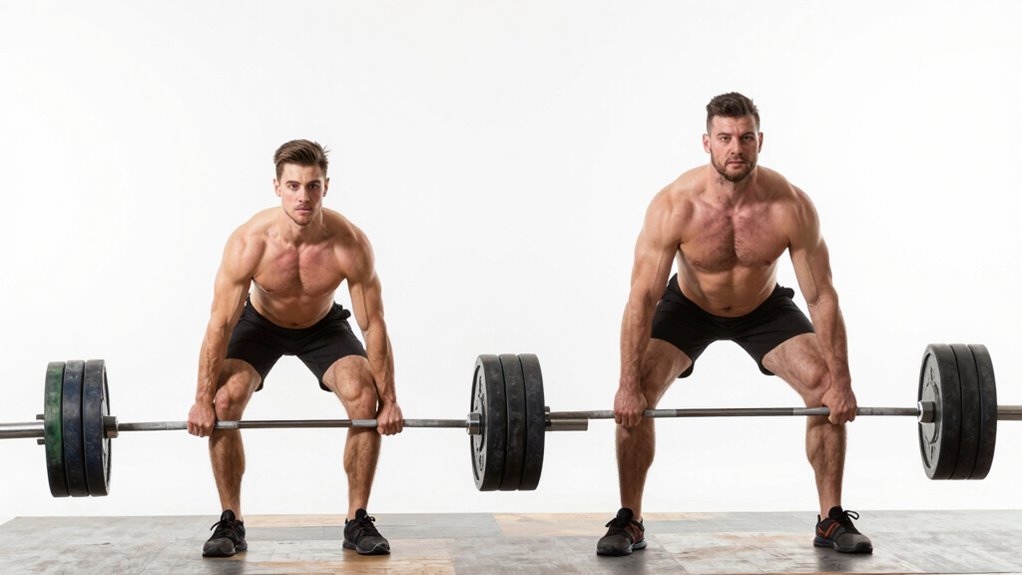

Choosing between the conventional and sumo deadlift depends on your body build. If you have longer arms and a strong posterior chain, the conventional style might suit you better. If you have a shorter torso or longer limbs, sumo can be more effective and easier on your back. Both styles require proper technique to prevent injury. Keep exploring to discover which deadlift matches your body and goals for maximum strength gains.
Key Takeaways
- Assess your limb proportions: longer arms favor conventional, while shorter torso and longer limbs suit sumo.
- Consider your body build: a more upright torso aligns with sumo, and a bent-over position aligns with conventional.
- Evaluate flexibility and mobility: sumo requires hip and ankle mobility; conventional demands more hamstring and lower back flexibility.
- Match your training goals: sumo reduces lower back strain, ideal for leg and hip focus; conventional emphasizes posterior chain strength.
- Prioritize proper technique and injury prevention based on your body type to choose the style that fits your biomechanics best.
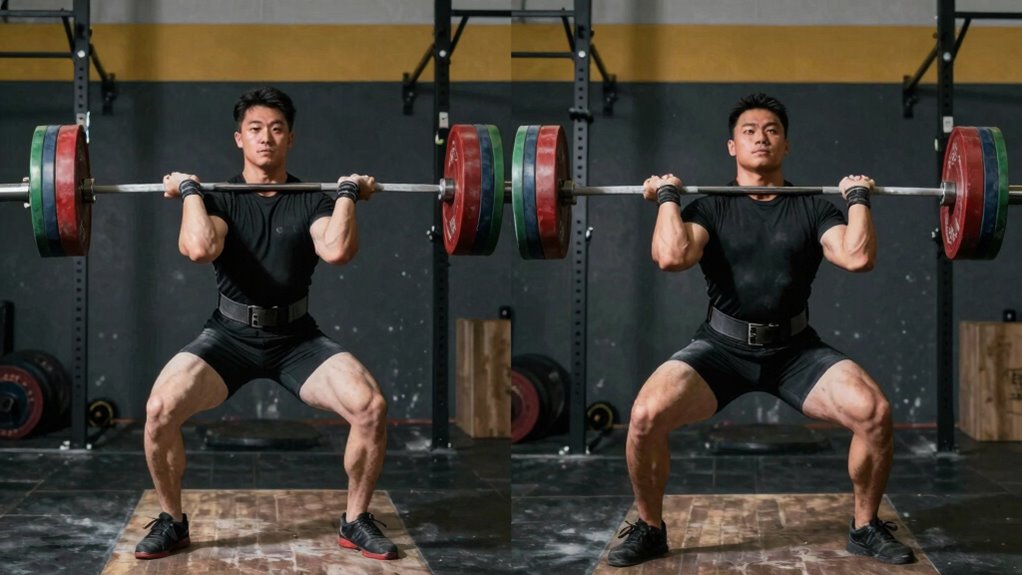
When it comes to deadlifting, choosing between the conventional and sumo styles can substantially impact your performance and safety. Your body build, flexibility, and strength distribution influence which style suits you best. Making the right choice isn’t just about personal preference; it requires understanding how each style demands technique adjustments and affects injury prevention.
Choosing between conventional and sumo deadlifts affects performance, safety, and injury prevention based on your body and technique.
The conventional deadlift involves placing your feet roughly hip-width apart, with your hands gripping the bar outside your knees. This stance emphasizes your posterior chain—your hamstrings, glutes, and back—making it a great choice if you have longer arms or a more favorable lever ratio for this style. However, because you bend more at the hips and lower back, technique adjustments become essential to maintain proper form. You need to focus on keeping your back flat, engaging your core, and avoiding rounding your shoulders to prevent strain. Proper technique adjustments are critical here, as improper form can lead to injuries such as herniated discs or strained lower back muscles.
On the other hand, the sumo deadlift positions your feet wider apart, with toes pointed outward, and your hands inside your knees. This stance reduces the range of motion and shifts some workload from your lower back to your hips and legs. If you have a shorter torso or longer limbs, sumo might feel more natural because it allows you to keep a more upright torso, minimizing the bend at your hips. Technique adjustments for sumo involve maintaining an upright chest, keeping your hips lower, and ensuring your knees track over your toes. These modifications are essential for injury prevention, particularly to avoid overstressing the knees or compromising your hip mobility. Proper form ensures you distribute the load evenly and reduce the risk of joint strain.
Choosing the right deadlift style also hinges on how well you adapt your technique. Both styles require deliberate adjustments to optimize performance and prevent injuries. If you notice discomfort or persistent pain, it’s often linked to technique flaws that could be corrected through coaching or practicing proper form adjustments. Remember, injury prevention starts with awareness of your body mechanics and making necessary modifications.
Additionally, understanding the importance of body mechanics and how they influence deadlift technique can significantly improve your lifting safety and effectiveness. Whether you opt for conventional or sumo, prioritize quality movement patterns over heavier weights to build strength safely. Listening to your body and focusing on technique adjustments will help you avoid setbacks and develop a deadlift style that aligns with your build and goals.

LOEFT Professional Powerlifting Deadlift Barbell, 92in 27MM Olympic Barbell for Powerlifting, Deadlift Bar for 45lb 1500 lbs Weight Capacity 190K PSI, Enhanced Flex Weight Bar Fit 2" Weights (Full Black)
PROFESSIONAL DEADLIFT BAR: With High-quality steel, tensile strength of 190,000 PSI and load capacity of 1500 pounds, LOEFT…
As an affiliate, we earn on qualifying purchases.
As an affiliate, we earn on qualifying purchases.
Frequently Asked Questions
Can I Switch Between Deadlift Styles Anytime I Want?
Yes, you can switch between deadlift styles anytime you want. This deadlift versatility allows you to experiment with different styles, which can improve your overall strength and prevent plateaus. Just pay attention to style shift timing; it’s best to incorporate changes gradually to avoid injury. Listen to your body, and give yourself time to adapt, ensuring your form stays solid and you maximize the benefits of each style.
Does My Gender Influence Which Deadlift Style Is Better?
Gender differences can influence which deadlift style suits you best, but physique considerations matter more. Statistically, women often have longer femurs relative to their torsos, making sumo deadlifts more comfortable for many. However, your individual build and mobility are key factors. Don’t let gender alone dictate your choice—try both styles to see which feels more natural and lets you lift heavier safely.
How Do I Prevent Injuries With Each Deadlift Style?
To prevent injuries with each deadlift style, focus on injury prevention through proper form correction. Always maintain a neutral spine, engage your core, and lift with your legs, not your back. Use light weights to master technique before increasing load. Pay attention to your body signals, and don’t rush reps. Regularly review your form, possibly with a trainer, to ensure safe, effective lifting and avoid strain or injury.
Are There Specific Footwear Recommendations for Each Style?
For deadlift footwear, choose shoes that provide stability and minimal cushioning. For both styles, flat-soled shoes or deadlift-specific shoes with a solid, non-compressible sole are ideal. Shoe recommendations include weightlifting shoes with a raised heel for better ankle mobility or flat shoes like Converse or Chuck Taylors. Avoid running shoes, as their cushioned soles can reduce stability, increasing injury risk during deadlifts.
How Long Does It Take to Master Each Deadlift Variation?
Mastering each deadlift variation varies wildly—don’t expect quick results. Training duration and skill progression depend on your starting strength, technique, and consistency. You might think you’ll be lifting like a pro in weeks, but it often takes months or even years. The journey’s unpredictable, so stay patient. The more dedicated you are, the faster you’ll improve, but mastery definitely isn’t an overnight feat.

MANUEKLEAR Deadlift Shoe – Weight Lifting Shoes for Men Women – Weightlifting Squat Shoes Fitness Cross-Trainer Barefoot Gym Training Sneakers Lemon Yellow
The Latest Deadlift Shoes for Men Women – M MANUEKLEAR, as a professional shoe and sports brand manufacturer,…
As an affiliate, we earn on qualifying purchases.
As an affiliate, we earn on qualifying purchases.
Conclusion
Ultimately, choosing between the conventional and sumo deadlift depends on your build and biomechanics. Don’t delay discovering your best match—deliberately determine what feels comfortable and powerful. Remember, the right lift increases confidence, minimizes injury, and maximizes results. So, try, tweak, and tune your technique until it feels natural. The key is knowing your body’s blueprint and boldly building strength without boundary. Find your fit, forge forward, and flourish in your fitness journey!

Powerlifting: The complete guide to technique, training, and competition
Description|Table of Contents|Author|Excerpts|Quotes
As an affiliate, we earn on qualifying purchases.
As an affiliate, we earn on qualifying purchases.

RitFit Weight Lifting Belt – Great for Squats, Lunges, Deadlift, Thrusters – Men and Women – 6 Inch Black/Camouflage
SUPER SUPPORTIVE & VERSATILE – The 6” extra-wide contoured weight lifting belt offers comprehensive support, stabilizing your back,…
As an affiliate, we earn on qualifying purchases.
As an affiliate, we earn on qualifying purchases.