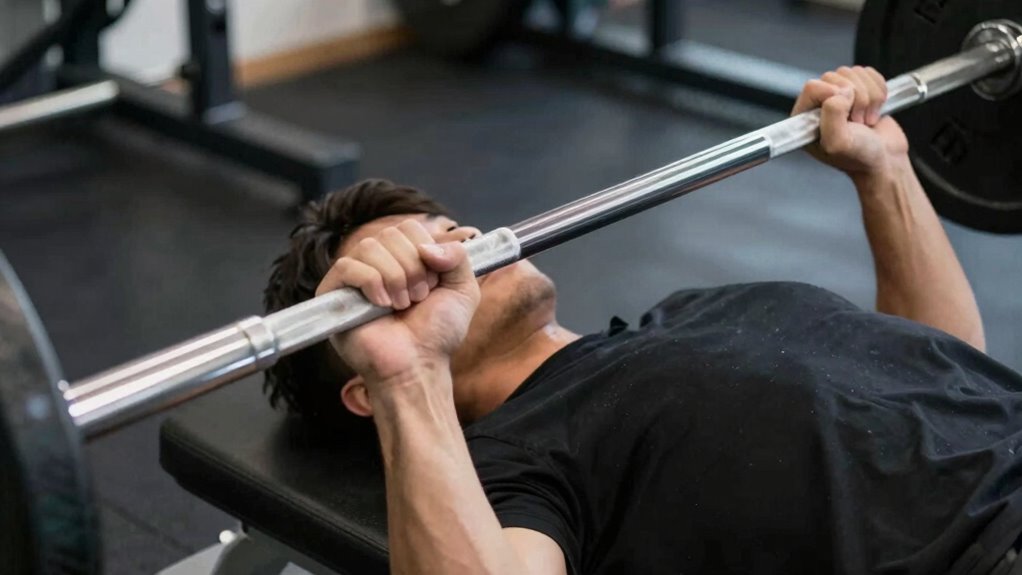
In a bench press, your bar should follow a smooth “J-curve” path, meaning it moves in a slight arc during movement. As you lower the bar, it should move inward toward your chest, then slightly outward as you press up. This pattern keeps your shoulder joints safe, maximizes muscle engagement, and allows you to lift more efficiently. Mastering this natural movement helps prevent injuries—stay with us to discover how perfecting this path can transform your lifts.
Key Takeaways
- The “J-curve” describes the bar’s slight arc during descent and ascent, starting above shoulders and moving inward toward the chest.
- Following the J-curve ensures safer shoulder positioning, reducing joint strain and injury risk.
- Proper bar path enhances muscle engagement of chest, shoulders, and triceps for more effective lifts.
- Deviating from the J-curve can cause shoulder instability, improper mechanics, and increased injury risk.
- Maintaining the J-curve promotes better movement control, strength development, and long-term joint health.
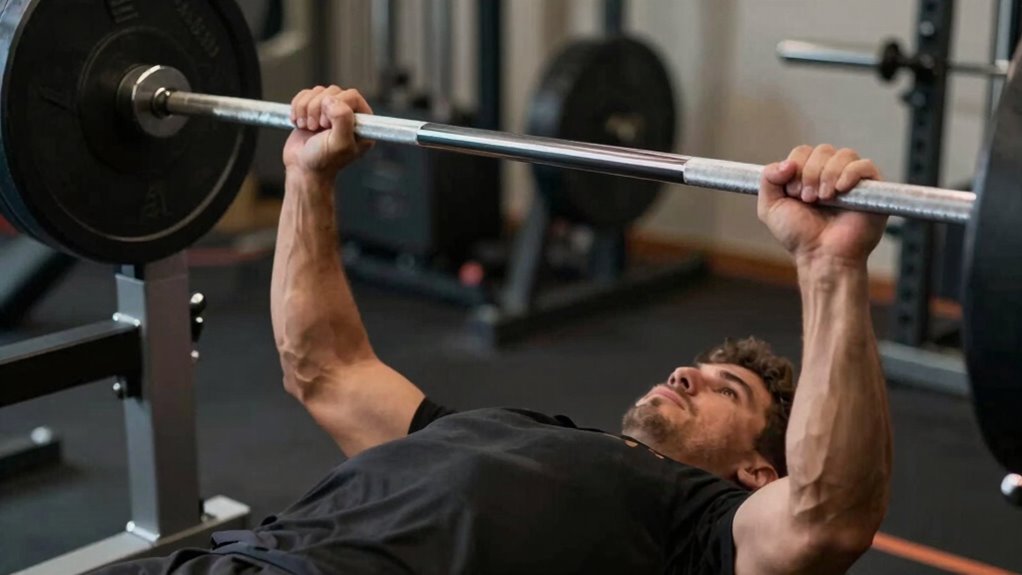
Have you ever wondered how the path of the bar during a bench press can impact your performance and safety? The way you guide the bar through its movement plays a vital role in your overall results and injury prevention. When you focus on proper movement mechanics, you guarantee that each repetition is efficient and safe. The bar doesn’t just move randomly; it follows a specific pattern, often called the “J-curve,” which helps maximize muscle engagement and reduce unnecessary strain on your joints.
Understanding the J-curve is key to mastering your bench press technique. As you lower the bar, it should follow a slight arc, moving from directly above your shoulders down and slightly inward toward your chest, then back up along a similar path. This curved movement allows your shoulder joints to stay in a safer, more natural range of motion, minimizing the risk of shoulder injuries. When your bar follows this path, you’re less likely to experience pain or strain, especially in the rotator cuff and shoulder capsule.
Following the J-curve ensures safer, more effective bench press movements and reduces shoulder injury risk.
Proper control of the bar path also enhances movement efficiency, allowing you to lift heavier weights with better form and less fatigue over time. Improper bar paths—like pressing the bar straight up or lowering it too far outward—disrupt your movement mechanics. Such deviations can overload certain muscles or joints, increasing the chance of injury. For example, pushing the bar too far inward or outward during the lift can cause your shoulders to rotate awkwardly, leading to instability or strain. By maintaining the correct J-curve, you promote proper muscle activation, engaging your chest, shoulders, and triceps efficiently. This not only enhances your strength gains but also protects your joints from undue stress.
Focusing on your bar path also helps you develop better proprioception, or body awareness during lifts. This means you’ll instinctively correct minor deviations, keeping your movement smooth and controlled. When you prioritize movement mechanics, you’re less likely to use compensatory techniques that could lead to injury. For example, some lifters tend to flare their elbows excessively or drift their wrists, which can cause joint pain over time. Staying conscious of your bar’s trajectory ensures your form remains ideal, reinforcing good habits that prevent injuries in the long run.
Ultimately, paying attention to your bar path isn’t just about lifting heavier weights; it’s about lifting smarter. When you adhere to the principles of proper movement mechanics, you maximize your performance while keeping your shoulders, elbows, and wrists safe. The J-curve isn’t just a visual pattern—it’s a strategic guide that helps you lift more effectively and with less risk. Incorporate this awareness into your training, and you’ll notice improvements in strength, stability, and injury prevention that last well beyond your next session.
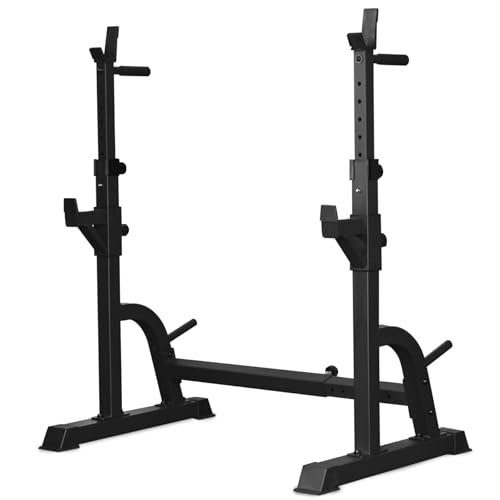
BARWING 49IN Rack For Bench Press Stand ,Barbell Rack Stand – Adjustable Multi-Functional Squat Barbell Stand for Weight Bench Press, weight bench rack, Easy to Assemble 350LBS Adjustable Squat Rack Stand
【Heavy-Duty Steel Construction for Maximum Stable】Built with commercial-grade steel and an extra-wide 52-inch base, this barbell rack for…
As an affiliate, we earn on qualifying purchases.
As an affiliate, we earn on qualifying purchases.
Frequently Asked Questions
How Can I Correct My Bar Path During the Bench Press?
To correct your bar path during the bench press, focus on technique adjustments and use coaching cues like “drive your hands back” and “keep your elbows tucked.” Make sure you’re pressing the bar in a slight arc, following the J-curve. Practice controlled reps, stay consistent, and consider recording your lifts to analyze your form. Seeking feedback from a coach can also help you make precise adjustments for a smoother, more efficient bar path.
Does the J-Curve Apply to All Bench Press Styles?
The J-curve in bench press biomechanics mainly applies to standard or flat bench presses. Different training variations, like incline or decline presses, alter the bar path and may not follow the classic J-curve pattern. So, no, it doesn’t apply to all styles—you should adjust your technique based on your specific bench press variation to optimize performance and reduce injury risk. Focus on proper form for each style you incorporate.
What Muscles Are Engaged During the J-Curve Bar Path?
During the J-curve bar path, you activate your chest, shoulders, and triceps muscles to push the weight. Stabilization muscles, like your rotator cuff and core, also engage to maintain control and balance throughout the movement. This coordinated muscle activation helps you lift efficiently and safely. By focusing on this path, you optimize muscle engagement, improving strength and stability while reducing injury risk during your bench press.
Is the J-Curve Ideal for Maximizing Strength?
The J-curve isn’t perfect for maximizing strength because it often leads to technique variations that can compromise your form. While it might target specific muscles, it increases injury prevention concerns since the inconsistent bar path can strain joints and tendons. For ideal strength gains, focus on a controlled, straight bar path, which promotes better technique and reduces injury risk, helping you lift heavier safely over time.
How Does Arm Length Affect the Bar Path?
Your arm length considerably influences your bar path and leverage during a bench press. Longer arms tend to create a more pronounced J-curve, making the lift more challenging but potentially offering greater leverage at the bottom. Shorter arms usually result in a straighter path, allowing for better control and efficiency. Understanding your arm length helps optimize your technique, ensuring you utilize leverage effectively and improve your overall bench press performance.
![Curved Squat Bar [Bells of Steel] Bench Press Bar, Curved Strength Training Barbell with Aggressive Knurl, 1500lb Weight Capacity](https://m.media-amazon.com/images/I/21SF2vBLmjL._SL500_.jpg)
Curved Squat Bar [Bells of Steel] Bench Press Bar, Curved Strength Training Barbell with Aggressive Knurl, 1500lb Weight Capacity
Ergonomic Squat Bar – Years of straight-bar lifting can be hard on your joints. Thankfully, the curve of…
As an affiliate, we earn on qualifying purchases.
As an affiliate, we earn on qualifying purchases.
Conclusion
Understanding the J-curve bar path helps you optimize your bench press technique and avoid injuries. By visualizing this smooth, curved movement, you’ll develop better control and strength. Isn’t it worth mastering the perfect path to release your full potential? Imagine feeling more confident and powerful with each lift, knowing you’re moving safely and efficiently. Keep practicing, stay mindful of your bar’s journey, and watch your gains soar. After all, the right path makes all the difference, doesn’t it?

SAWANS Bench Press Sling Power Weight Lifting Training Fitness Increase Strength Push Up Gym Workout (Red, Large)
We're So Confident You're Going To Love Your New SAWANS Bench Press Sling. Ultra High Quality Material The…
As an affiliate, we earn on qualifying purchases.
As an affiliate, we earn on qualifying purchases.

VEVOR Safety Squat Bar, 700 LBS Fitness Squat Bar, Safety Squat Bar Attachment with Shoulder and Arm Pads, 28mm Diameter Weight Bar, Ideal for Front Squats, Lunges, Rehab, Physical Therapy
Standard Size for 4-Seaters: This transparent golf car cover is designed for the EZGO TXT and most 4-seater…
As an affiliate, we earn on qualifying purchases.
As an affiliate, we earn on qualifying purchases.