
If you’re struggling to feel your calves work, it’s likely due to anatomy, improper form, or ineffective training methods. Calf muscles contain mixed fiber types, making them hard to activate fully without specific focus. To fix this, slow down your reps, focus on full range of motion, and vary exercises to target all angles. Improving your mind-muscle connection, stretching, and adjusting your training can make a big difference—keep exploring to learn more ways to boost your gains.
Key Takeaways
- Poor mind-muscle connection reduces muscle activation; focus on slow, controlled reps and visualization to improve engagement.
- Using improper form or limited exercise variations prevents full calf recruitment; incorporate diverse angles and techniques.
- Insufficient stretching and mobility restricts range of motion, hindering full contraction and activation during exercises.
- Overtraining or undertraining disrupts fatigue and recovery, making it harder to feel the muscles working effectively.
- Neglecting progressive overload and exercise tempo diminishes stimulus, reducing the sensation of effort and muscle activation.

FlowKeepers Wireless EMS Calf Stimulator & Leg Circulation Device | FDA-Cleared Muscle Activator for Leg Comfort, Tired & Achy Legs | Portable for Travel, Office & Home (2-Pack)
✅ FDA-CLEARED & FSA/HSA ELIGIBLE: FlowKeepers is a fully FDA-Cleared medical device—not a generic gadget—designed to safely and…
As an affiliate, we earn on qualifying purchases.
As an affiliate, we earn on qualifying purchases.
Why Are Your Calf Muscles So Hard to Activate?

Have you ever wondered why your calves feel so stubborn and hard to activate during workouts? It’s often because of calf fatigue, which can set in quickly if you don’t give your muscles enough time to recover or if your training isn’t targeting them properly. Additionally, muscle symmetry plays a role—if one calf is stronger or more developed than the other, it can be harder to activate both evenly during exercises. This imbalance causes some muscles to underperform, making full activation difficult. Your calves also have a high density of slow-twitch fibers, which resist fatigue but require specific stimuli to engage fully. To overcome this, focus on proper form, balanced training, and gradual intensity increases to improve activation and reduce fatigue. Incorporating proper warm-up techniques can also help prepare your muscles for activation and reduce the likelihood of fatigue hindering your progress. Paying attention to muscle recruitment during exercises can ensure you’re engaging the targeted muscles more effectively. Additionally, understanding the muscle fiber composition of your calves can help tailor your training approach for better results. Recognizing the importance of muscle balance between both calves can also contribute significantly to more effective activation and development. Utilizing techniques like mind-muscle connection can further enhance your ability to activate these muscles effectively.

TEMI Slant Board for Calf-Stretching – Wooden Incline Wedge Stretcher for Squats, Foot & Ankle Mobility, Portable Fitness Equipment, Balance Block for Heel Stretch
👍𝗣𝗢𝗥𝗧𝗔𝗕𝗟𝗘 & 𝗟𝗜𝗚𝗛𝗧𝗪𝗘𝗜𝗚𝗛𝗧 — This calf stretcher slant board is designed for easy transport, weighing just 5 lbs….
As an affiliate, we earn on qualifying purchases.
As an affiliate, we earn on qualifying purchases.
Understanding Calf Anatomy: How It Affects Growth

Understanding the unique structure of your calf muscles reveals why growth can sometimes feel slow or uneven. Your calves contain a mix of muscle fibers—some fast-twitch, some slow-twitch—that respond differently to training. This variation influences how your muscles develop over time. Additionally, nerve activation plays an essential role; if your nervous system isn’t effectively signaling your calf muscles during exercises, they won’t contract fully, limiting growth. Proper activation ensures you recruit as many muscle fibers as possible, leading to better gains. Recognizing these factors helps you tailor your training to target both fiber types and improve nerve engagement. Muscle fiber types also respond differently to various training stimuli, which can influence your overall progress. By understanding your calf anatomy, you can optimize your workouts for more consistent, noticeable growth. Engaging in specific drills that enhance neural recruitment can further improve muscle activation and development, especially when combined with techniques that promote muscle fiber recruitment. Incorporating exercise variation can also stimulate different muscle fibers for more balanced growth. Additionally, understanding muscle adaptation mechanisms can help you adjust your training intensity to prevent plateaus and promote continuous progress.

WIKDAY Resistance Bands for Working Out Exercise Loop Bands Workout Bands Set for Men Women Body Stretching, Training, Home Workout, Physical Therapy, Booty Legs, Set of 5 (Assorted)
Premium Package: WIKDAY professional resistance loop bands includes 5pcs different levels , they are all 12in length and…
As an affiliate, we earn on qualifying purchases.
As an affiliate, we earn on qualifying purchases.
Common Mistakes That Prevent Your Calves From Growing

One common mistake is not balancing training volume, either overdoing it or not training enough, which can hinder growth. Selecting the wrong exercises or not targeting your calves effectively also prevents progress. Paying attention to these issues is key to unblocking your calves’ potential. Additionally, understanding how targeted muscle engagement can enhance growth is essential for effective calf development muscle activation techniques. Incorporating anti-fatigue mats into your routine can also improve overall comfort and focus during calf workouts, leading to better results. Recognizing the importance of personality assessments can provide insights into your training preferences and motivations, helping you stay consistent and motivated. Proper training variation can also prevent plateaus and stimulate continued muscle growth, making your workouts more effective over time.
Overtraining and Undertraining
Many people mistakenly believe that more training always leads to faster calf growth, but overtraining can actually hinder progress. When you push your calves too hard or too often, muscle fatigue sets in, making it harder for them to recover and grow. High training frequency without adequate rest prevents your muscles from fully repairing, leading to diminished gains. On the other hand, undertraining limits stimulus, preventing growth altogether. Finding the right balance is key. Instead of doing endless sets every day, focus on quality over quantity. Allow sufficient recovery time between sessions, and listen to your body. Properly managing training frequency guarantees your calves stay fresh, recover fully, and respond effectively to your workouts. Incorporating foam rolling techniques can also help improve blood flow and recovery, making your training more effective. Additionally, paying attention to your training intensity ensures you’re challenging your muscles without risking overtraining or injury. To optimize results, understanding training variables like volume, intensity, and rest periods is crucial for effective calf development. Recognizing the importance of adequate recovery can prevent burnout and promote steady progress. Incorporating proper nutrition can further support muscle repair and growth, maximizing your training efforts.
Improper Exercise Selection
Choosing the wrong exercises can markedly hinder your calf development. If you stick to only one movement, like standing calf raises, you limit exercise variation and miss out on targeting different parts of your calves. This reduces muscle activation and prevents balanced growth. Incorporate a variety of exercises, such as seated, standing, and donkey calf raises, to hit all angles and ensure thorough development. Focusing on different movement patterns encourages your muscles to activate fully and adapt properly. Without proper exercise variation, your calves may plateau or feel unstimulated, making it harder to grow. To maximize gains, choose a mix of exercises that challenge your calves in multiple ways, stimulating muscle activation from different angles and promoting overall size and strength.

MZDXJ Muscle Roller Massage Roller Stick- Deep Tissue Fascia Blaster for Myofascial Pain Relief, Lymphatic Drainage & Body Sculpting, Handheld Physical Therapy & Recovery Tool (Purple Black-18 inch)
[🌟Precise targeting] Our product can reach deep into muscle trigger points. Its professional massage design effectively relieves muscle…
As an affiliate, we earn on qualifying purchases.
As an affiliate, we earn on qualifying purchases.
How to Boost Your Mind-Muscle Connection During Calf Exercises

To strengthen your mind-muscle connection during calf exercises, focus on moving mindfully rather than rushing through reps. Using proper exercise variations can also keep your muscles engaged and prevent plateaus. These strategies help you get the most out of each workout and see better gains. Paying attention to your body jewelry measurements and ensuring proper fit can also enhance your awareness of muscle engagement during movement.
Focus on Mindful Movement
Focusing on mindful movement can considerably enhance your calf workouts by strengthening the connection between your mind and muscles. When you practice mindful movement, you become more aware of how your calves respond during each rep. Focused engagement means paying close attention to the muscle you’re working, rather than just going through the motions. Slow down your reps, breathe intentionally, and concentrate on feeling the stretch and contraction. Visualize the muscle working and imagine it growing stronger with each movement. This heightened awareness helps you activate the targeted muscles more effectively, making your workouts more efficient. Incorporating mind-muscle connection techniques can further amplify your training results. By staying present and attentive, you’ll improve your neuromuscular control, leading to better gains and a more satisfying training experience. Regularly monitoring your signs of illness or injury can help prevent setbacks and ensure consistent progress. Additionally, cultivating a growth mindset can motivate you to persist through challenges and continually improve your technique. Developing better body awareness can also assist in identifying areas needing adjustment for optimal performance.
Use Proper Exercise Variations
Incorporating a variety of exercise variations can substantially enhance your ability to connect with your calf muscles. Try different angles, such as seated, standing, or donkey calf raises, to target different parts of your calves. Including a calf stretch before and after your workouts improves ankle mobility, making your movements more effective. Better ankle mobility allows you to perform calf exercises through a full range of motion, increasing muscle activation. Experiment with exercises that emphasize slow, controlled reps and pause at the top to deepen your mind-muscle connection. These variations prevent adaptation and keep your calves engaged. By diversifying your routine and focusing on ankle mobility, you’ll develop a stronger, more responsive mind-muscle link during every calf exercise. Recognizing the importance of ethics in genetic testing can also influence how you approach your training, ensuring your methods align with your values and promote overall well-being.
Best Calf Exercises to Maximize Activation and Growth

Are you looking to maximize calf muscle activation and promote growth? Incorporate exercises that target both the gastrocnemius and soleus muscles. Start with standing calf raises, focusing on a full range of motion, and include a calf stretch afterward to improve ankle mobility. Don’t skip stretching, as it helps release more movement and enhances activation. Seated calf raises are also effective for isolating the soleus, especially if you keep your knees bent. To boost engagement, try adding resistance bands or holding weights. Remember, improving ankle mobility allows you to perform better reps and stretch deeper during each exercise. Consistently challenging your calves with these exercises and mobility work will lead to stronger, larger muscles over time.
Using Range of Motion and Tempo to Develop Stronger Calves
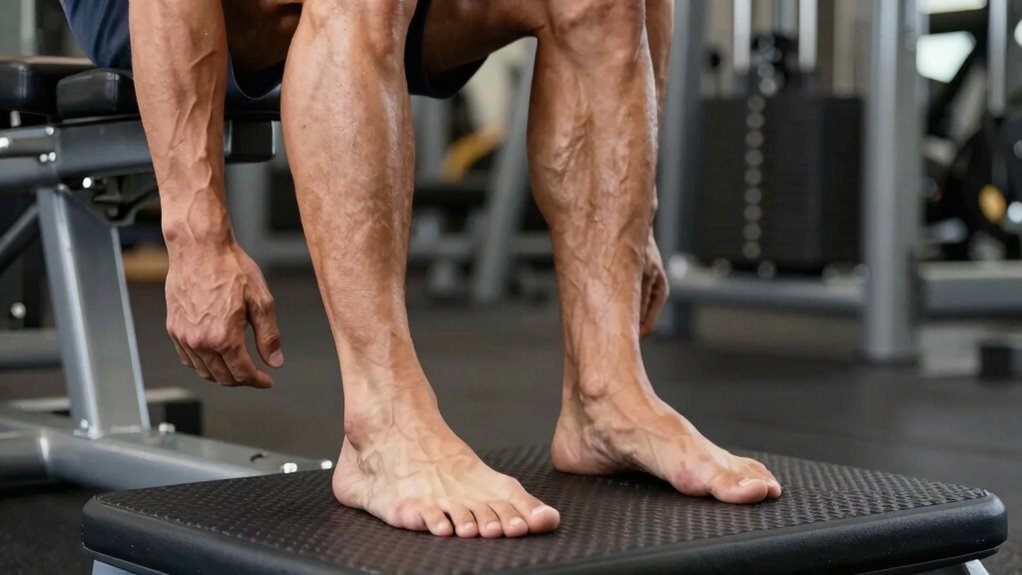
To build stronger calves, focusing on progressive range of motion guarantees you’re challenging your muscles through their full capacity. Controlling your tempo during each rep maximizes tension and stimulates growth effectively. By consistently adjusting these factors, you’ll open better gains and overall strength.
Progressive Range of Motion
Progressive range of motion is a highly effective method for building stronger calves by gradually increasing the movement’s depth and control. This approach boosts calf flexibility and improves ankle mobility, essential for releasing your full potential. To harness its benefits, focus on:
- Increasing your range gradually, ensuring smooth, controlled movements.
- Maintaining proper form to prevent injury and maximize engagement.
- Incorporating deep stretches to enhance flexibility over time.
- Using slow, deliberate reps to build strength through full range.
Tempo Control for Growth
Controlling your tempo during calf exercises enhances the effectiveness of your range of motion work by emphasizing slow, deliberate movements. This controlled tempo boosts muscle elasticity, allowing your calves to stretch fully and contract more powerfully. It also helps maintain proper calf hydration, preventing tightness and improving overall flexibility. By slowing down the eccentric (lowering) phase, you give your muscles time to engage fully, leading to stronger, more resilient calves. A deliberate tempo reduces momentum, ensuring you target the muscle fibers effectively. Consistent tempo control fosters better mind-muscle connection and stimulates growth. Incorporating tempo variations into your routine optimizes calf development, making your workouts more efficient and helping you feel your calves working throughout each movement.
Stretching and Flexibility Tips for Better Calf Gains
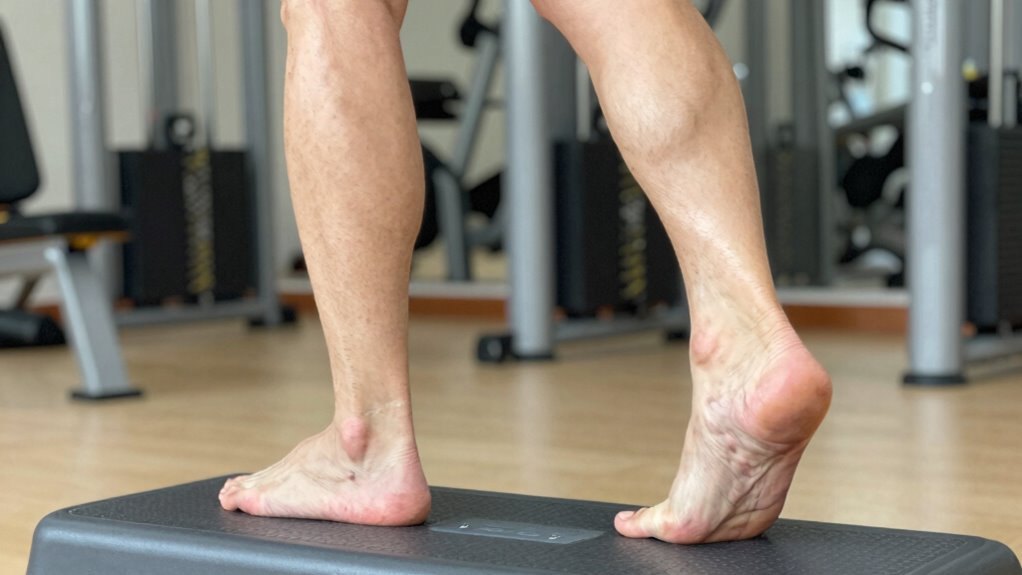
Improving your calf gains isn’t just about lifting heavier; incorporating effective stretching and flexibility exercises can make a significant difference. Proper calf stretching and flexibility routines help release tight muscles, increase range of motion, and activate your calves more effectively during workouts. To get started, try these tips:
- Hold each stretch for at least 30 seconds to deepen flexibility.
- Perform daily calf stretches to prevent tightness and improve mobility.
- Use dynamic stretches like leg swings to warm up before training.
- Focus on consistent, gentle stretching rather than forcing your muscles, so gains come gradually and safely.
Adjusting Sets, Reps, and Training Variables for Calf Growth

To maximize calf growth, you need to adjust your sets, reps, and training variables strategically. Incorporate a good calf stretch to enhance flexibility and guarantee your muscles are prepared for intense work. Vary your reps between moderate and high ranges to target different muscle fibers, promoting growth. For example, use higher reps (15-20) to induce muscle fatigue and stimulate hypertrophy, while lower reps (8-12) build strength. Pay attention to muscle fatigue during each set; stopping before complete exhaustion can prevent injury and improve recovery. Adjust your training variables consistently based on how your calves respond. This approach helps you find the best balance between intensity and volume, encouraging continuous growth and avoiding plateaus.
How to Track Your Calf Progress and Know When You’re Improving

Tracking your calf progress helps you stay on course and make informed adjustments to your training. To know when you’re improving, focus on these key indicators:
- Calf measurement: Regularly measure your calves to see tangible growth over time.
- Progress photos: Take clear photos from consistent angles to visually track changes.
- Strength improvements: Notice increases in reps or weight, signaling strength gains.
- Sensation and pump: Feeling a stronger pump and less discomfort during workouts indicates adaptation.
Overcoming Plateaus in Calf Training: Tips and Strategies
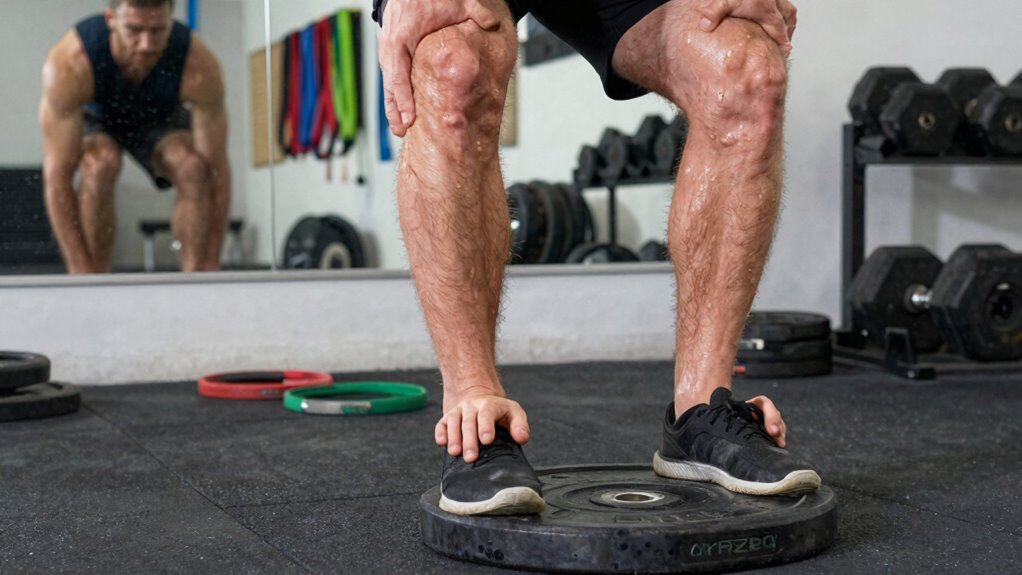
Hitting a plateau in calf training can be frustrating, but it’s a common hurdle that can be overcome with targeted strategies. One key is to push through calf muscle fatigue by varying your exercises and increasing intensity gradually. Incorporate different angles and equipment, like standing and seated calf raises, to target all parts of the muscle. Staying consistent with your calf training routine is essential; inconsistency hampers progress and stalls growth. You might also try adding extra sets, reducing rest time, or employing advanced techniques like drop sets or tempo training to challenge your calves further. Remember, patience is crucial. With persistent calf training consistency and strategic adjustments, you’ll break through plateaus and see continued improvements.
Frequently Asked Questions
What Supplements Can Enhance Calf Muscle Growth?
You can try calf supplements like creatine, which boosts muscle energy and growth, or beta-alanine to improve endurance and performance. Muscle growth aids such as branched-chain amino acids (BCAAs) support recovery and muscle repair. Remember, supplements work best when combined with consistent training, proper nutrition, and adequate rest. Always consult a healthcare professional before adding new supplements to your routine to verify they suit your individual needs.
How Often Should I Train My Calves Weekly?
You should train your calves 2-3 times weekly for ideal growth. Imagine Sarah, who added calf stretching and ankle mobility exercises to her routine; she noticed increased strength and better engagement during workouts. Incorporate these elements into your training, and don’t forget to allow rest days for recovery. Consistency is key, so listen to your body and gradually increase intensity to see steady progress.
Can Genetics Limit Calf Development?
Genetic limitations can influence your calf development, but they don’t set your muscle potential in stone. While some people have naturally smaller or slower-growing calves, consistent training, proper form, and targeted exercises can still lead to significant improvements. Focus on progressive overload and variety in your workouts. Remember, genetics may play a role, but dedication and smart training release your calves’ full potential, regardless of your genetic background.
Does Training Calves Daily Improve Growth?
Training your calves daily can boost growth if you focus on proper technique. For example, if you incorporate calf flexibility exercises alongside strength training, you’ll see better results and reduce calf injury risk. Regular, moderate workouts help solidify gains and prevent overtraining. Consistency is key—just avoid overdoing it—and you’ll develop stronger, more resilient calves while minimizing injury chances.
How Do Footwear and Surface Affect Calf Training?
Footwear impact and training surface considerably influence your calf training. Wearing supportive shoes can limit ankle mobility, reducing calf engagement, while barefoot or minimal shoes enhance muscle activation. Training on a firm, flat surface ensures stability and proper form, preventing injury and maximizing effort. Switching up footwear and surfaces helps target different calf muscles, improving growth and strength. Pay attention to these factors to get the most out of your calf workouts.
Conclusion
So, next time your calves refuse to cooperate, remember—they’re just playing hard to get. Maybe they’re secretly plotting to keep you humble or just testing your patience. Either way, with the right tweaks and a bit of persistence, you’ll finally crack the code. Or maybe, just maybe, your calves are the universe’s way of reminding you that some muscles are better left untrained. Keep going—you’re not giving up on those stubborn calves just yet.