TL;DR

Get workout gear delivered free with Prime
- Fast, free delivery on millions of items
- Prime Video, Amazon Music and more included
- Member-only deals all year
Fit&Well published a yoga therapist’s seven-part seated movement routine for older adults, including arm raises, twists, side bends and a forward fold. The therapist says people should move within their own capacity; the report does not establish that the routine is suitable for every health condition or provide clinical evidence of specific benefits.
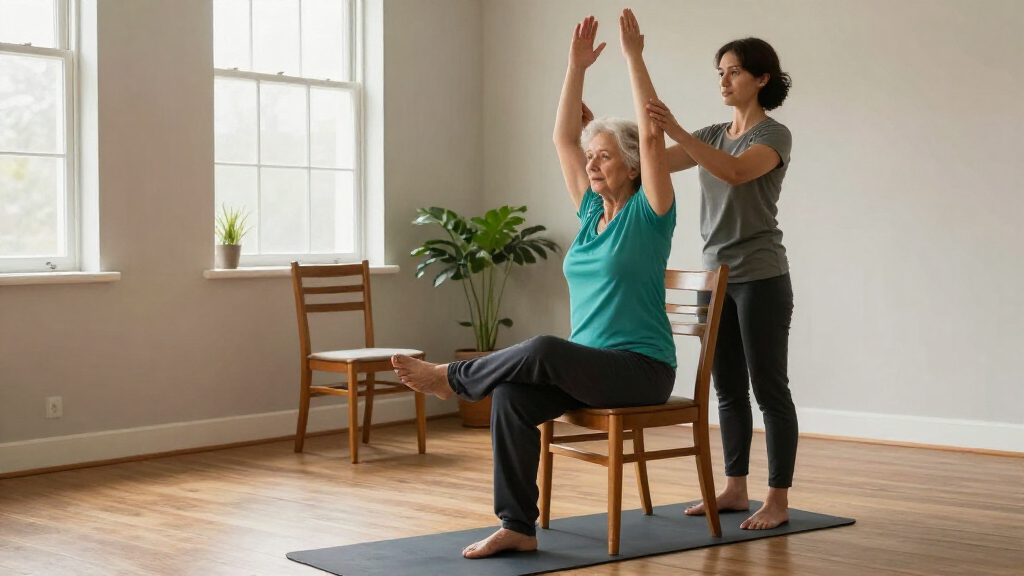
Fit&Well has published a yoga therapist’s seven-part chair-based movement sequence for older adults, including people who may find floor exercises difficult or prefer to move while seated. The therapist describes the routine as gentle but potentially energizing and advises readers to adapt each movement to their body’s range and capacity.
The routine begins with a one-minute settling exercise: sit toward the back of a chair, keep both feet flat on the floor, sit upright and allow the breath to find a natural rhythm. The remaining movements are given as short sets rather than a timed workout: an arm sweep into prayer, seated twists, alternating and double arm raises, side bends, seated cat-cow and a forward fold. Most are suggested for three to five repetitions, with twists and side bends performed three times on each side.
The therapist’s instructions coordinate movements with breathing. For example, the arm sweep rises on an inhale and returns toward the chest on an exhale; twists alternate from side to side, returning to center between turns. In the cat-cow movement, the chest lifts as the hands slide toward the hips, then the back rounds as the hands move toward the knees. The forward fold can be adjusted by keeping the hands on the knees rather than reaching down.
The source recommends a sturdy chair and enough surrounding space to lift the arms. It also offers a stability option for side bends: hold the side of the chair instead of extending the lower arm. These are instructions in the published routine, not an individualized assessment or a claim that every exercise is appropriate for every reader.
A Seated Option for Movement
The routine gives readers a structured way to try movement without getting down onto the floor. That may be relevant to older adults who have limited mobility, prefer chair-based activity or want a low-complexity sequence they can adapt. Its short sets and seated starting position may make the exercises easier to approach, though the article does not compare outcomes with other forms of exercise.
The therapist also emphasizes that the goal is not to achieve a particular pose. That guidance matters because the sequence includes bending, twisting and raising the arms, movements that can feel different from person to person. Readers should treat the directions as general suggestions rather than proof of a health benefit or a substitute for advice tailored to their needs.
Products Worth Considering

Therabody Theragun Relief Massage Gun, 3-Speed, Navy

Levoit Core 300S-P Smart WiFi Air Purifier

Garmin Venu® 3 Premium Fitness Smartwatch 45mm Black
As an affiliate, we earn on qualifying purchases.
How the Chair Flow Is Structured
The report presents the routine through the perspective of a yoga therapist who says their work includes older adults living with Parkinson’s, other movement disorders and chronic health conditions. The therapist says they use chair-based yoga both with people who lack the mobility for floor-based movement and with people who simply feel more comfortable in a chair. These details describe the therapist’s stated practice; the source does not report a clinical trial or research study of the sequence.
The seven movements progress from settling into the chair to broader movement of the arms and upper body. Each exercise includes brief setup instructions, repetitions and, for two movements, an easier variation. The available source material does not give a publication date, identify a named therapist, or report measured results from participants who performed the flow.
“I encourage everyone to move within the range and capacity of their body—there’s no particular shape or position to achieve.”
— The yoga therapist quoted in Fit&Well
Safety and Evidence Questions
The source does not establish whether the exercises are appropriate for a particular person’s medical condition, balance, pain or range of motion. It also does not provide clinical evidence that the sequence improves mobility, mood or other health outcomes. The therapist’s descriptions of group members’ experiences are reported observations, not results from a controlled study.
Readers with a chronic condition, recent injury, pain, balance concerns or movement restrictions may need individualized advice before trying the sequence. The report does not specify how to modify every movement for different conditions, nor does it set out warning signs for when to stop.
Trying the Routine With Care
Fit&Well’s report offers the sequence as an activity readers can try with a sturdy chair and clear space, adapting the movements to what feels accessible. It gives no announced follow-up study, clinical review or scheduled next milestone. Anyone who is unsure whether a movement is suitable can seek guidance from a qualified health professional or yoga therapist familiar with their needs.
If attempting the exercises, readers can begin with the settling position and keep movements small and comfortable, using the chair for support where needed. The therapist’s instructions call for exploration rather than reaching a prescribed shape; the published routine does not require readers to complete all seven movements.
Key Questions
What exercises are included in the chair routine?
The seven movements are settling into the chair, an arm arc into prayer, seated twists, single and double arm raises, side bends, seated cat-cow and a forward fold.
How many repetitions does the routine recommend?
Most movements are suggested for three to five repetitions. The twists and side bends are listed as three repetitions on each side; the initial settling exercise is timed for one minute.
What equipment and space are needed?
The report calls for a sturdy chair and enough space around it to raise the arms comfortably. It does not list any other equipment.
Can the exercises be changed for extra support?
Yes. The report suggests holding the side of the chair during a side bend for added stability, and placing the hands on the knees during the forward fold. The therapist also advises moving within each person’s capacity.
Does the report show that the routine is safe or effective for everyone?
No. It presents a therapist’s recommendations and observations, not clinical evidence that the sequence is suitable for everyone or produces specific health outcomes. People with health conditions, pain, balance concerns or movement restrictions can seek personalized professional advice before trying it.
Source: fitandwell.com