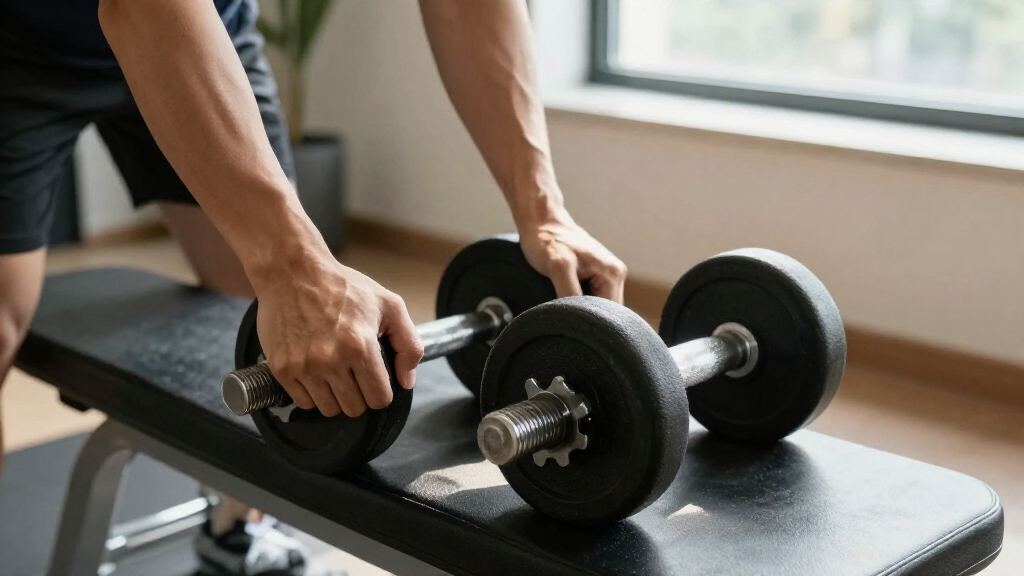
Set up your compact adjustable dumbbells, select a manageable weight, and complete a short strength session with them. This guide is for beginners using a compatible pair of selector-style dumbbells at home. Allow 20-30 minutes for setup and a first workout; the exact time depends on your model and how many exercises you do.

Get workout gear delivered free with Prime
- Fast, free delivery on millions of items
- Prime Video, Amazon Music and more included
- Member-only deals all year

BowFlex Results Series SelectTech Dumbbells (Pair)
- ✔ Weight range: 5–52.5 lbs per dumbbell
- ✔ Set: Pair
- ✔ Total item weight: 110.6 lbs

LifeOG FDB2 Adjustable Dumbbell Set (25 lbs Pair)
- ✔ Weight range: 4–25 lbs per dumbbell
- ✔ Total set weight: 50 lbs
- ✔ Quantity: 2 dumbbells

Lifepro Adjustable Dumbbells for Home Gym, Quick-Adjust
- ✔ Weight range: 5–25 lbs (confirm whether per dumbbell)
- ✔ Adjustment increments: 2.5 lbs
- ✔ Set description: 25 lb pair
Difficulty: Beginner | Time: 20-30 minutes
What You’ll Need
Tools & Materials:
- A compatible pair of compact adjustable dumbbells
- The manufacturer’s instruction manual
- A stable, level floor and the dumbbell storage trays
- Workout clothes and supportive shoes
Knowledge:
- Basic familiarity with squats, hinges, presses, and rows, or willingness to start with light practice repetitions
- Ability to stop exercising if you feel sharp pain, dizziness, or unusual shortness of breath
Check the manual for the dumbbells’ weight range, adjustment method, handling limits, and required maintenance. Selector mechanisms differ across brands. Do not assume that a dial, pin, or lever works the same way on another model.
BowFlex Results Series SelectTech Dumbbells (Pair)
When we want one compact set to cover both lighter exercises and more demanding strength work, BowFlex makes the clearest case. Its dial-adjustable range runs from 5 to 52.5 pounds per dumbbell, far beyond the listed limits of either LifeOG or Lifepro. That extra headroom can make a difference as training progresses, and the product description says the set replaces 15 separate weights. The included trays also give the pair a designated storage place, which helps keep a home workout area organized.The tradeoff is substantial: at 110.6 pounds total, this is not a lightweight set to carry between rooms. Its listed dimensions are compact relative to a rack of individual weights, but buyers still need room for the dumbbells and trays. BowFlex also uses plastic and rubber components alongside metal plates, so buyers who prioritize an all-metal build may prefer LifeOG’s cast iron core and PE coating. Compared with Lifepro’s 2.5-pound steps, the listed BowFlex details do not specify increment sizes, so we should confirm that the available steps suit our progression needs before buying.This is our top pick for breadth, not the simplest set to relocate. Choose it when heavier loads and long-term range matter more than keeping the total package easy to move. For lighter workouts in a particularly tight room, Lifepro is easier to consider; for a robust grip and automatic locking feature, LifeOG has more explicit details.
Pros:
- Adjusts from 5 to 52.5 pounds per dumbbell, the broadest range in this comparison.
- Dial changes load without requiring a rack of separate fixed dumbbells.
- Includes storage trays for keeping the set organized between workouts.
- Non-slip ergonomic handle is designed for controlled handling.
Cons:
- The 110.6-pound total set weight makes it cumbersome to transport.
- Plastic and rubber components may not suit buyers seeking an all-metal build.
- The supplied specifications do not state the weight increments.
Best for: Home strength trainers who want a broad weight range and can dedicate a stable storage area to a heavy pair and its trays.
Not ideal for: Buyers who frequently move equipment, need a very light set, or specifically want stated small adjustment increments.
Bottom line: BowFlex is the most versatile choice here when we value a wide training range more than easy portability.
“BowFlex is the most versatile choice here when we value a wide training range more than easy portability.”
LifeOG FDB2 Adjustable Dumbbell Set (25 lbs Pair)
LifeOG is the more focused alternative to BowFlex: it gives us a smaller, lighter range, while emphasizing the feel and security of the dumbbell in hand. Each unit adjusts across five settings from 4 to 25 pounds, and the description says changes take one second. Its automatic dual-lock system is designed to secure plates as we lift, a useful feature to look for when exercises take the weights overhead. The 33 mm rubber grip is also wider than Lifepro’s listed one-inch handle diameter, which may appeal to buyers who prefer a more substantial hold.Those benefits come with a specific workflow. We must return the dumbbell to its base to adjust it, so quick changes depend on having that base nearby and setting the weight down between adjustments. Lifepro’s dial approach is also described as quick, and its 2.5-pound increments offer more clearly defined smaller steps. LifeOG’s supplied information does not spell out the exact increments between its five settings, so it may be less suitable for someone who wants tightly controlled load increases. Its cast iron core and PE coating make it heavier and bulkier than some alternatives, although that construction may be preferable to a buyer who wants to avoid a mostly plastic feel.Against BowFlex, LifeOG gives up much of the upper range: it stops at 25 pounds per dumbbell rather than 52.5. In return, the set has a more detailed grip specification and a stated locking mechanism. We see it as a sensible middle choice for moderate-load training with frequent exercise changes, provided the base-based adjustment and limited range fit our routines.
Pros:
- Five settings span 4–25 pounds per dumbbell.
- One-second adjustment is intended to keep transitions brief.
- Automatic dual-lock system is designed to secure plates during lifts.
- 33 mm rubber grip offers a substantial, slip-resistant hold.
Cons:
- Weight changes must be made with the dumbbell placed on its base.
- Five fixed settings may not provide the smaller progressions some users want.
- Cast iron construction makes the units heavier and bulkier than some compact alternatives.
Best for: Home exercisers who train mostly at moderate loads and value a wide rubber grip and an explicitly described automatic lock.
Not ideal for: People who need fine incremental progression, want to change settings without using a base, or expect to lift above 25 pounds per dumbbell.
Bottom line: LifeOG suits moderate home training where a substantial grip and automatic plate locking matter more than fine increments or heavier loads.
“LifeOG suits moderate home training where a substantial grip and automatic plate locking matter more than fine increments or heavier loads.”
Lifepro Adjustable Dumbbells for Home Gym, Quick-Adjust
Lifepro stands out for giving us the most specific small-step progression among these three options: its adjustable range is described as 5 to 25 pounds in 2.5-pound increments. That can make it easier to move up gradually or choose a lighter load for an exercise without jumping among a few widely spaced settings. Its listed dimensions, 13.6 inches long by 6.7 inches wide, are also the most compact dimensions supplied for any set here, giving it an edge for a confined workout area.There is an important specification caveat. The product description says 5–25 pounds, while the supplied spec lists the item weight as 25 pounds and describes a “25lb Pair”; we should check the listing carefully to confirm the per-dumbbell range and set configuration before relying on it for programming. Even taking the stated range at face value, this is the lowest ceiling in the comparison: LifeOG lists up to 25 pounds per dumbbell, while BowFlex reaches 52.5. The 1-inch handle is also narrower than LifeOG’s 33 mm grip, so those who like a fuller hold may favor LifeOG.Lifepro is the most space-conscious choice on the listed dimensions, and alloy steel construction gives it a sturdier material description than a plastic-heavy set. Still, its load limit makes it better suited to lighter full-body routines, beginners, and accessory exercises than to long-term heavy strength training. Choose it for compact storage and gradual lighter progression; step up to BowFlex if heavier training is central, or consider LifeOG if its grip and locking details are more important than smaller increments.
Pros:
- Product description specifies 2.5-pound increments for gradual progression.
- Listed dimensions are the smallest in this comparison.
- Alloy steel construction and a non-slip grip are specified.
- Quick-adjust mechanism is designed for changes between exercises.
Cons:
- The stated maximum is far below BowFlex’s 52.5 pounds per dumbbell.
- The provided weight and pair specifications are ambiguous and should be confirmed.
- Its 1-inch handle is narrower than LifeOG’s listed 33 mm grip.
Best for: Beginners and lighter-load home exercisers who want compact listed dimensions and 2.5-pound adjustment steps.
Not ideal for: Strength trainees who need substantial room to progress, or buyers unwilling to verify the pair and per-dumbbell weight details.
Bottom line: Lifepro is a compact option for lighter training and small load increases, provided we confirm its exact pair configuration before purchase.
“Lifepro is a compact option for lighter training and small load increases, provided we confirm its exact pair configuration before purchase.”
As an Amazon Associate we earn from qualifying purchases.
Before You Start
Inspect the dumbbells and trays for cracks, loose parts, or damage. Place each tray on a hard, level surface with enough room to lift the handles straight up and return them without hitting furniture. Keep children and pets away during setup and exercise.
Never change a selector setting while lifting a dumbbell or while it is outside its tray. Do not drop adjustable dumbbells: impact can damage the mechanism or cause plates to come loose. If a weight does not lock or the handle does not lift smoothly, stop and consult the manual.
Step-by-Step Instructions
Step 1: Position the trays
Place both trays on a stable, level floor with the handles facing the direction shown in the manual. Leave clear space around them so you can stand, lift, and return each dumbbell without twisting or reaching over other equipment.
Tip: Keep the trays on a surface that will not shift when you lift the dumbbells. Avoid carpet edges, sloping floors, and loose mats.
Check: Both trays sit flat and cannot rock or slide when you press gently on their edges.
Step 2: Inspect and identify the adjustment system
Read the model’s instructions and identify how its weight selector works. Inspect the handle, weight plates, selector dial or pin, and tray for visible damage. Confirm that the numbers and settings are readable.
Tip: Some models require the handle to sit fully in the tray before you turn a selector. Follow the sequence given for your exact model.
Check: You can identify the approved selector setting and the parts that should remain in the tray during adjustment.
Step 3: Select the lightest practical starting weight
Place each dumbbell fully into its tray, then set both selectors to a light load suitable for practice. Keep the settings matched for two-handed exercises unless your program calls for different loads. Do not force a dial or pin past a marked setting.
Tip: If you are unsure which load to choose, start at the low end of the dumbbell’s range. You can increase the weight after you can complete each repetition with control.
Check: The selectors show the same intended load, and both handles remain fully seated in their trays.
Step 4: Check the lock before lifting
Follow the manual’s check for confirming that the selected plates are secured. With the dumbbell still in the tray, use only the gentle test described by the manufacturer; do not shake it or lift it by a plate. If the selector does not align or the handle feels loose, reseat it and set the load again.
Tip: Never use a dumbbell that makes an unusual clicking sound, has a plate that shifts, or fails its model-specific lock check.
Check: The selector aligns with a marked setting and the manufacturer’s lock check passes without looseness or unusual movement.
Step 5: Practice lifting and returning one dumbbell
Stand close to the tray, bend at your hips and knees, and grip the handle firmly. Lift the dumbbell straight out without tilting or twisting it. Lower it back into the tray slowly, align it with the slots, and confirm it is fully seated before releasing your grip.
Tip: Keep your back steady and avoid reaching across your body. If the dumbbell catches, lower it into place and realign it instead of forcing it.
Check: You can lift and return the dumbbell smoothly, and it sits flush in the tray afterward.
Step 6: Warm up and rehearse the movements
Walk or march gently for a few minutes, then rehearse body-weight squats, hip hinges, wall presses, and standing rows without dumbbells. Move through a comfortable range and keep each repetition controlled.
Tip: If you have a health condition, recent injury, or uncertainty about whether strength training is appropriate for you, ask a qualified health professional for guidance before starting.
Check: You can perform the practice movements without losing balance or feeling sharp pain.
Step 7: Complete a short first workout
Use the light setting for one or two sets of 8-10 controlled repetitions of a squat, hip hinge, floor press, and one-arm row. Rest as needed between sets. Keep the dumbbells close to your body when moving between positions, and stop each set while you can still maintain good form.
Tip: A suitable starting load lets you finish the repetitions steadily, without swinging, holding your breath, or straining to complete the final movement.
Check: You complete the planned repetitions with stable posture, controlled movement, and no sharp pain.
Step 8: Return the dumbbells and reset the selectors
Lower each dumbbell fully into its tray. Confirm it is seated before changing its setting. Return the selector to the manufacturer’s recommended storage setting if the manual specifies one, then check that no plates are left outside their assigned positions.
Tip: Store the dumbbells in their trays rather than on a bench, shelf, or floor where they can roll or be knocked over.
Check: Both dumbbells sit securely in their trays, with the plates aligned and the storage area clear.
Common Mistakes to Avoid
- Turning the selector while the dumbbell is lifted or partly outside its tray. — Seat the dumbbell fully before changing its setting, and follow the adjustment order in the manual.
- Choosing a load that is too heavy for controlled repetitions. — Begin with a light setting. Increase the load only when you can complete the planned repetitions with steady form.
- Dropping or banging the dumbbells into the trays. — Lower each dumbbell slowly and guide the handle into the tray slots. Impact can damage the selector or plates.
- Assuming both dumbbells are set to the same load without checking. — Read both selector indicators before lifting, especially after changing settings.
Troubleshooting
Problem: The handle will not lift out of the tray.
Solution: Set it down fully, check that the selector points to a marked setting, and confirm the handle is aligned as shown in the manual. Remove any obstruction. Do not pry or force it; contact the manufacturer if it remains stuck.
Problem: A selector dial or pin will not turn or insert.
Solution: Return the dumbbell to the tray and check that it is fully seated. Make sure the selector is at a valid setting and follow the stated adjustment sequence. Stop if it still resists.
Problem: A plate appears loose after selection.
Solution: Do not lift or use the dumbbell. Place it fully in the tray, reset the selector, and repeat the manufacturer’s lock check. If the plate still moves, stop using the unit and ask the manufacturer for service instructions.
Problem: The starting load feels too difficult during a set.
Solution: Stop the set and return the dumbbell to the tray. After it is seated, select a lower load and try a few controlled repetitions. If movement remains painful or unstable, stop the workout.
What Success Looks Like
You have set up the trays on a stable surface, selected a marked load, passed the model’s lock check, and completed a short practice workout with controlled repetitions. Both dumbbells finish fully seated in their trays with aligned plates and no signs of damage or looseness. During exercise, you should feel muscular effort, not sharp pain.
Next Steps
Record the load, exercises, sets, and repetitions you completed. On later sessions, repeat the same load until the movements feel steady across all planned repetitions. Then increase the load by one available setting, if appropriate, and check your form again. Wipe the handles and trays according to the manufacturer’s care instructions, and inspect the selector and plates before each workout. Stop using a damaged or unreliable dumbbell and contact its manufacturer for model-specific help.
Frequently Asked Questions
How heavy should I set compact adjustable dumbbells as a beginner?
Choose a light load that lets you complete each repetition slowly and with stable form. If you have to swing the weight, hold your breath, or shorten the movement to finish, return the dumbbell to its tray and select a lower setting.
Can I change the weight while holding the dumbbell?
No. Put the dumbbell fully into its tray before changing the setting. A selector may not engage correctly when the plates are under load or the handle is out of position.
Why do the selected plates stay in the tray?
The mechanism generally lifts only the plates needed for the selected load. Check that the handle is aligned, the selector points to a valid setting, and the dumbbell is fully seated. Use the instructions for your model if the handle does not lift cleanly.
How can I tell when to increase the weight?
When you can complete all planned repetitions with steady control and without pain, try the next available setting in a later workout. Increase gradually and reduce the load again if your form breaks down.