TL;DR

Get workout gear delivered free — and shop member deals
- Fast, free delivery on millions of items
- Access to Prime Big Deal Days deals on October 6–7
- Prime Video, Amazon Music and more included
Fit&Well has published a 10-minute beginner Pilates routine by instructor Hannah Lawrence of Sundrop Pilates designed to improve back and hip mobility. The seven-move flow requires no equipment and pairs each exercise with a video demonstration. Instructors advise moving slowly and stopping if any movement causes pain.
Fitness publication Fit&Well has published a 10-minute beginner Pilates routine designed to ease stiffness in the back and hips, put together by Hannah Lawrence, an instructor with Sundrop Pilates. The sequence of seven mat-based and standing exercises requires no equipment beyond a mat and is accompanied by video demonstrations for each movement.
The routine consists of seven moves: a pelvic curl or bridge (6–8 repetitions), cat-cow (10 repetitions), a mermaid side bend (one minute per side), a single-leg forward fold (30–60 seconds per side), a single-leg hamstring stretch (one minute per side), a Pilates roll down (3–4 repetitions) and supine knee rocks (5 repetitions per side). The full session is billed as a 10-minute flow suitable for beginners.
According to Lawrence, the aim is functional improvement rather than isolated stretching. “The idea is that sitting cross-legged and reaching toward your toes will start to feel more comfortable and natural,” she told Fit&Well. She advises moving slowly through the exercises and making sure each one feels like a stretch but does not cause pain.
Several of the movements include modifications for tight muscles. In the roll down, for example, Lawrence recommends bending the knees more if the hamstrings are tight; in the supine hamstring stretch, she suggests pointing and flexing the foot a few times if it feels good. The pelvic curl is performed by peeling the spine off the mat one vertebra at a time until knees, hips and shoulders are aligned, then rolling back down on the exhale.
Why Short Mobility Routines Matter
The routine reflects a broader shift toward short, equipment-free mobility sessions that fit into busy schedules. Fit&Well frames joint care as a long-term investment: the outlet writes that keeping joints strong and mobile now supports easier movement in later years. A 10-minute format lowers the barrier to entry for beginners who may find longer programmes intimidating.
The focus on the back and hips targets areas commonly affected by prolonged sitting, and the exercise selection — spinal articulation, lateral bending and hamstring work — is structured around positions used in daily life, such as sitting cross-legged and reaching toward the toes. These are the publication’s and instructor’s stated aims; the routine is presented as supportive mobility work, not as treatment for any medical condition, and anyone with existing back or hip problems should consult a qualified professional before starting.
How the Routine Is Structured
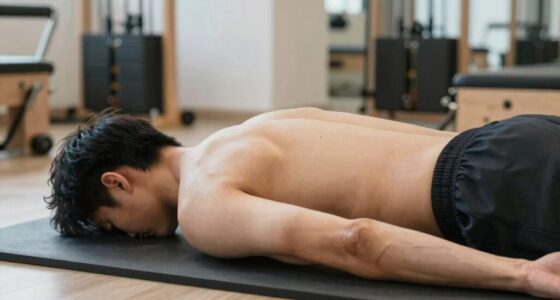
Each exercise in the Fit&Well feature is paired with a video demonstration, sourced from physiotherapy and Pilates channels on YouTube, showing correct form. The flow moves from loaded spinal work (pelvic curl) through mobilisation (cat-cow), lateral stretching (mermaid side bend), seated and supine hamstring stretches, and finishes with a standing spinal roll down and supine knee rocks that rotate the lower back while the shoulders stay anchored to the mat.
Repetition counts and hold times are specified for every move, ranging from 3–4 repetitions for the roll down to a one-minute hold per side for the hamstring stretch. This is the latest in Fit&Well’s series of short, instructor-led routines that combine mobility and low-resistance strength work.
“Keep them strong and mobile now, and you’ll be able to move with ease when you’re older.”
— Fit&Well
What the Routine Does Not Promise
The routine is presented as mobility support, and Fit&Well does not cite clinical research measuring its effects. There is no data in the published feature on outcomes such as measurable flexibility gains, and individual results will depend on factors including consistency, existing flexibility and any underlying conditions. Readers with back or hip pain, injuries or diagnosed conditions should seek guidance from a doctor or physical therapist before starting, since general routines are not tailored to individual needs.
Getting Started With the Flow
Readers can follow the full routine, including exercise descriptions and video demonstrations, on the Fit&Well website. The outlet also sends weekly workout ideas, health tips and wellbeing advice by newsletter. Beginners are advised by the instructor to perform the movements slowly, stop if anything causes pain, and treat the session as regular mobility maintenance rather than a one-off fix.
Key Questions
How long does the Pilates routine take?
The full session is designed to take about 10 minutes, covering seven exercises with specified reps or hold times for each.
Do I need any equipment?
No equipment beyond an exercise mat is required. All moves are mat-based except the standing Pilates roll down.
Is the routine suitable for beginners?
Yes. Fit&Well presents it as a beginner flow, with video demonstrations and modifications — such as bending the knees more if the hamstrings are tight.
What should I do if an exercise hurts?
Instructor Hannah Lawrence advises that each move should feel like a stretch but not cause pain. Stop any movement that hurts, and consult a health professional if you have existing back or hip problems.
What is the goal of the routine?
According to Lawrence, the aim is to make everyday positions — such as sitting cross-legged and reaching toward your toes — feel more comfortable and natural over time.
Source: rss
Fall Picks
fall essentials
As an affiliate, we earn on qualifying purchases.