To estimate your 1RM without maxing out, perform a few sets with submaximal weights, lifting lighter loads for multiple reps until you feel fatigued. Record the weight lifted and reps completed, then apply a common formula like the Brzycki formula to estimate your max. This method keeps you safe while providing accurate benchmarks. Keep exploring how these formulas work to better understand your strength potential and optimize your training.
Key Takeaways
- Perform submaximal lifts at a lighter weight for multiple reps until near failure.
- Record the weight used and the number of repetitions completed.
- Use a proven estimation formula, like Brzycki’s, to calculate your 1RM from these values.
- Ensure consistent testing conditions to track progress accurately over time.
- Adjust your training loads based on the estimated 1RM for safety and effectiveness.
Have you ever wondered how much weight you can lift for a single repetition? Many people ask this question because knowing your 1RM, or one-repetition maximum, helps tailor effective training programs. But testing your true max can be risky, leading to injury or unnecessary fatigue. Fortunately, there are ways to estimate your 1RM without maxing out directly. Understanding this process is key to optimizing your workout programming and managing training intensity safely.
One common approach involves using submaximal lifts—lifting lighter weights for multiple repetitions—as a basis for estimation. For example, you might perform a set with a weight you can lift around 5 to 10 times before failure. Once you record that weight and the number of reps you completed, you can apply an estimation formula to determine your 1RM. This method is not only safer but also provides a good gauge of your strength level without pushing your limits too hard. Additionally, consistent testing and estimation can help track your progress over time and adjust your training accordingly.
Workout programming becomes more precise when you incorporate these estimations. Instead of arbitrarily choosing weights, you can set targets based on percentages of your 1RM. For instance, if your goal is strength, you might work at 85-95% of your estimated max. If you’re focusing on endurance, lighter weights at higher reps work better. Using estimated 1RM values allows you to adjust your training intensity intelligently, ensuring you’re challenging yourself without risking overtraining or injury.
Several formulas exist to convert submaximal lifts into 1RM estimates, with the Brzycki formula being one of the most popular. This formula takes the weight lifted and the number of reps performed and calculates an estimated max. For example, if you lift 100 pounds for 8 reps, the formula can give you an approximate 1RM. This estimate helps guide your workout programming, giving you a clear target for future sessions. Remember, these formulas are estimates—your actual max might differ slightly, but they’re reliable enough for most training purposes.
Monitoring your progress over time by regularly estimating your 1RM helps you see improvements without risking injury. As you get stronger, your estimated max will increase, and you can adjust your training loads accordingly. This ongoing process ensures you’re training with the right intensity, pushing your limits safely and effectively. Overall, estimating your 1RM without maxing out is a smart strategy for anyone serious about strength training. It allows for precise workout programming, helps manage training intensity, and keeps you progressing steadily while minimizing risk. Keeping a training log can further enhance the accuracy of your progress tracking.
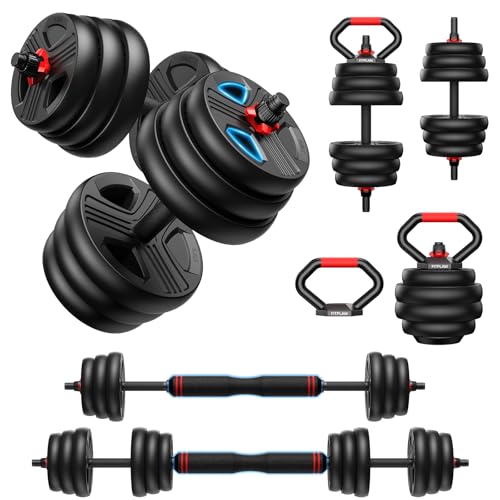
FDS1 Adjustable dumbbell set, 45lbs Free Weights set with upgraded nut, 5 in 1 Weight Set Used as Kettlebells, Barbell, Push up Stand, Fitness Exercise for Home Gym Suitable Men/Women
- Versatile 5-in-1 Design: Transforms into dumbbells, kettlebells, barbells, and more
- Secure Dual-Lock Nuts: Red and black locking system prevents weight shifting
- Adjustable Weight Options: Customize weights from light to heavy for all levels
As an affiliate, we earn on qualifying purchases.
As an affiliate, we earn on qualifying purchases.
Frequently Asked Questions
Can I Estimate My 1RM for Multiple Exercises Accurately?
Yes, you can estimate your 1RM for multiple exercises accurately by considering exercise variability and using proper estimation methods. Focus on consistent form and controlled reps, then apply formulas like Epley’s or Brzycki’s. Keep in mind, estimation accuracy may vary across different exercises due to their unique movement patterns. Regularly update your estimates to track progress and guarantee reliable results across various lifts.
How Often Should I Re-Estimate My 1RM?
Think of your progress like a finely tuned engine; you should re-estimate your 1RM every 4 to 6 weeks. This allows you to adjust your training frequency and keep progress tracking on point. Regular updates prevent plateaus, ensuring you’re lifting maximally. If your lifts feel easier or harder, it’s a sign to reassess sooner. Consistent re-evaluations keep your training aligned with your current strength level.
Does Body Weight Affect 1RM Estimation Accuracy?
Yes, body weight can affect 1RM estimation accuracy. Heavier individuals may have higher estimates due to greater muscle mass, but fat mass can skew results. Conversely, lighter people might underestimate their strength. To improve accuracy, consider body composition alongside body weight. Recognize that fluctuations in weight can influence your estimations, so regularly update your assessments and use multiple methods for the most reliable results.
Are There Risks Involved in Estimating 1RM Without Maxing Out?
Estimating your 1RM without maxing out can be safe if you follow proper safety considerations, but injury risks still exist. You should use appropriate weights, maintain proper form, and avoid pushing too hard, especially if you’re feeling fatigued. Always have a spotter or safety equipment on hand, and listen to your body. If unsure, consult a trainer to minimize injury risks during submaximal testing.
Can I Use Estimation Methods for Olympic Lifts?
You can definitely use estimation methods for Olympic lifts. Did you know that about 70% of lifters rely on these techniques to track progress? When estimating, focus on proper lifting techniques and make equipment adjustments as needed to guarantee safety and accuracy. These methods help you gauge your strength without risking injury, keeping your training effective and consistent while respecting the unique demands of Olympic lifts.

2PCS Body Measure Tape 60inch (150cm), Automatic Telescopic Tape Measure for Body Measurement & Weight Loss, Accurate Tape Measure for Tailor, Sewing, Fitness, Handcrafts, Clothes
- Includes 2 measuring tapes: Two 60-inch (150cm) tapes for versatility
- Flexible and accurate: Retractable with pin-lock and push-button
- Durable fiberglass material: Soft, long-lasting, and safe for skin
As an affiliate, we earn on qualifying purchases.
As an affiliate, we earn on qualifying purchases.
Conclusion
Now that you’ve got the tools to estimate your 1RM without pushing to the brink, you’re like a skilled navigator charting a course through uncharted waters. Remember, it’s not about testing your limits every time, but about steering safely toward progress. With these methods, you’ll build strength steadily, like a sturdy oak growing stronger with each season. Keep your eye on the horizon, and watch your gains blossom without the risk of burnout.

Taja Fitness Workout Journal & Log Book for Women & Men, Fitness Planner
- Workout Tracking Sections: Log exercises, sets, reps, and weights
- Goal Setting and Tracking: Set up to 10 fitness goals
- Pre and Post-Workout Data: Record measurements and progress
As an affiliate, we earn on qualifying purchases.
As an affiliate, we earn on qualifying purchases.

FitBeast Grip Strengthener Forearm Strengthener Hand Grips Strengthener Kit – 5 Pack Adjustable Resistance (Black)
- Ergonomic Design: Contoured shape reduces strain and fatigue
- Portable and Premium Materials: Compact, textured handle, non-slip rubber for durability
- Adjustable Resistance: Customize resistance for all skill levels
As an affiliate, we earn on qualifying purchases.
As an affiliate, we earn on qualifying purchases.