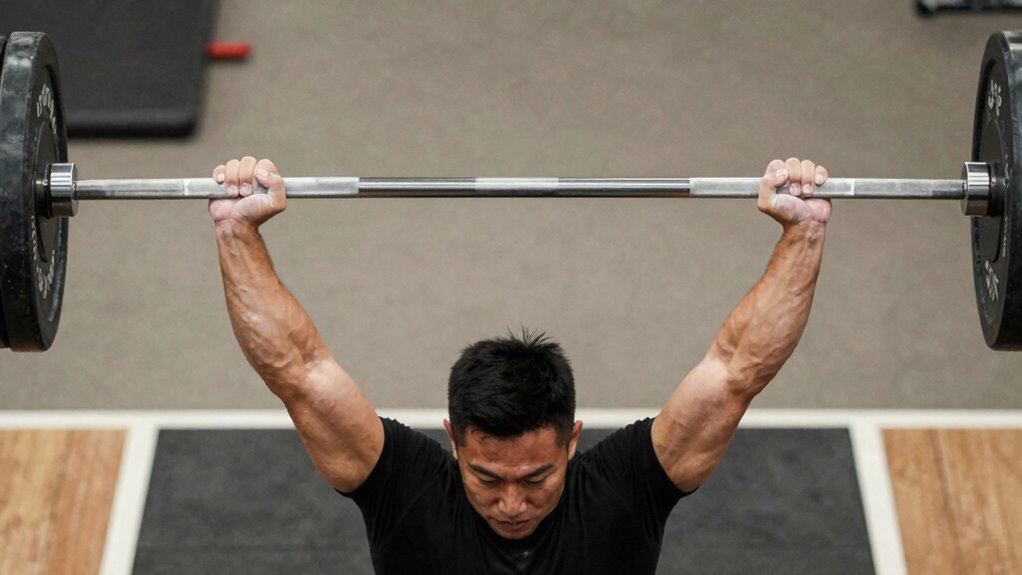
To fix your mid-range sticking points in the overhead press, focus on tracking the bar along a slightly diagonal, vertical path from head to overhead. Keep your shoulders retracted, chest up, and engage your core for stability. Practice slow reps, use mirrors or recordings, and make certain your grip and stance are solid. Correcting your bar path will boost power and efficiency, helping you push through those tough spots. If you want to learn more, keep exploring techniques to improve your form.
Key Takeaways
- Maintain a slightly diagonal bar path, starting over the head and moving vertically or slightly back to optimize power.
- Keep elbows under the bar and wrists aligned to prevent bar drift and mid-range sticking.
- Engage your core and retract shoulders to stabilize upper body and guide the bar smoothly.
- Use slow, controlled reps and pause at the sticking point to reinforce proper mechanics.
- Regularly monitor and adjust grip width, stance, and bar position with mirrors or recordings for better control.
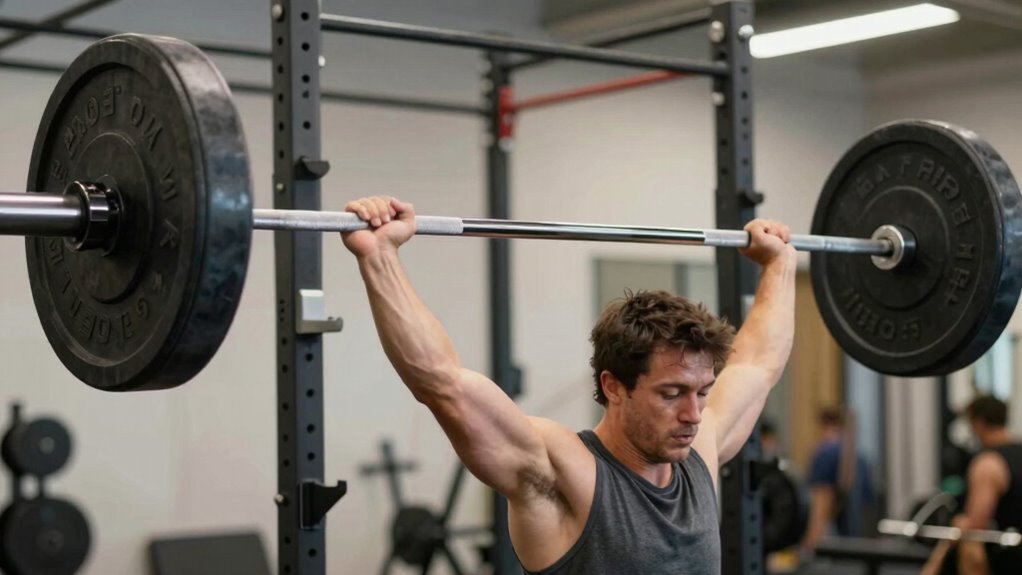
Understanding the bar path during the overhead press is essential for improving your technique and lifting efficiency. When your bar follows an ideal path, you generate more power, reduce unnecessary strain, and minimize the risk of injury. Conversely, a flawed bar path can cause your reps to get stuck mid-range, making it difficult to complete lifts smoothly. To fix this, you need to focus on bar path mechanics—how the bar moves through space during each repetition—and make targeted training adjustments to correct any inefficiencies.
Proper overhead press form ensures efficient lifts, reduces injury risk, and helps overcome sticking points.
Start by observing the trajectory of your bar during lifts. Ideally, the bar should move in a slightly diagonal line, starting just over your head and moving vertically or slightly back as you press upward. If the bar drifts forward or drops downward mid-rep, it indicates your form needs correction. A common issue is that your elbows flare out too early or your wrists collapse, causing the bar to deviate from its ideal path. By paying close attention to these details, you can identify where your technique falters and make precise training adjustments.
One effective training adjustment involves focusing on shoulder positioning and core engagement. Keep your chest up and shoulders slightly retracted to maintain a stable upper body, which helps keep the bar on its proper course. Strengthening your core also provides better control and stability during the lift, preventing the bar from wandering forward or backward. Practice slow, controlled presses with a lighter weight to reinforce proper bar path mechanics. Use a mirror or record your lifts to visually confirm that your bar remains aligned over your midline.
Another adjustment pertains to grip width and stance. A grip that’s too narrow or too wide can influence your ability to keep the bar on a smooth course. Experiment with your hand placement to find the position that allows for the most direct, efficient movement. Additionally, ensure your feet are shoulder-width apart with a solid base, so your entire body works together to guide the bar vertically. Incorporate pause reps at the top and bottom of the movement to develop awareness of your bar’s position and reinforce proper mechanics.
If you find yourself stuck mid-rep, pause briefly at the sticking point to reset your form and re-engage your muscles. This pause helps you correct any deviations from your ideal bar path and builds strength in the vulnerable mid-range position. Paying attention to bar path mechanics and practicing with intention will help you overcome sticking points and develop a more efficient, powerful overhead press. Remember, fixing your bar path isn’t about rushing but about precision, control, and making small, deliberate training adjustments to elevate your lifts.

Ultimate Body Press XL Doorway Pull Up Bar with Elevated Bar & Adjustable Width
GET OUT OF THE DOORWAY: Effectively build muscle across the chest, arms, back, and core with pull-ups, push-ups,…
As an affiliate, we earn on qualifying purchases.
As an affiliate, we earn on qualifying purchases.
Frequently Asked Questions
How Do I Identify My Personal Bar Path Issues?
To identify your personal bar path issues, start with bar path analysis during your overhead press. Watch for any forward or backward movement, especially mid-rep. Limited shoulder mobility often causes uneven paths, so assess your shoulder flexibility and mobility first. If your bar drifts excessively or feels off balance, it indicates a technique or mobility problem. Improving shoulder mobility and focusing on controlled, straight movements can help fix these issues.
What Rolling or Shifting Techniques Improve Bar Path?
Imagine the bar path as a gentle arc, flowing smoothly from start to finish. To improve it, visualize this movement during lifts. Use technique adjustments like slight rolling or shifting your grip or stance to guide the bar more directly overhead. These subtle shifts help align your bar path, reducing strain and improving efficiency. Focus on consistent bar path visualization, and refine your technique adjustments to keep the bar moving in a controlled, ideal trajectory.
Can Specific Warm-Ups Correct Bar Path Deviations?
Yes, specific warm-up routines and stretching protocols can correct bar path deviations. You should incorporate dynamic warm-ups that activate shoulder and chest muscles, along with targeted stretching to improve flexibility. Focus on mobility drills and light sets before heavy lifts, which help you develop better control and positioning. This preparation primes your muscles and joints, leading to more consistent bar path and smoother overhead presses.
How Does Grip Width Influence Overhead Press Bar Path?
Did you know that a wider grip can reduce shoulder strain for many lifters? Your grip width directly influences your overhead press bar path by affecting shoulder mobility and stability. A narrower grip often promotes a more vertical bar trajectory, while a wider grip may cause the bar to drift forward. Adjusting your grip positioning helps optimize movement and minimizes injury risk, especially if shoulder mobility is limited.
Are There Exercises to Strengthen the Shoulder Stabilizers?
To strengthen your shoulder stabilizers, focus on exercises targeting the rotator cuff and scapular stability. Incorporate external rotations with a resistance band, prone Y raises, and scapular push-ups into your routine. These movements engage your rotator cuff muscles and improve scapular control, helping prevent injuries and enhance overhead pressing performance. Consistently training these stabilizers builds a solid foundation for safer, more effective overhead movements.

Therapist’s Choice® Shoulder Pulley, Over The Door, with Patient Guide. Aids Recovery and Rehabilitation of Shoulder, Rotator Cuff, Shoulder Pain, Frozen Shoulder, Pain Free Range of Motion (Black)
HOME THERAPY: Get the same kind of therapy used by doctors and physical therapists in the comfort of…
As an affiliate, we earn on qualifying purchases.
As an affiliate, we earn on qualifying purchases.
Conclusion
Think of your overhead press like guiding a boat through choppy waters. When your bar path stays steady and on course, you navigate smoothly past mid-range sticking points. But if your boat veers off course, you’ll stall. By mastering your bar path, you’re the captain who keeps the vessel moving forward, no matter the turbulence. Stay focused on that straight line, and you’ll sail past those stubborn reps with confidence and ease.

Barbell Hearbeat Decal | Weightlifting Gym Powerlifting Decal | Barbell Vinyl Decal | Fitness Car Decal Bumper Sticker Window Laptop Tumbler Decal | 7.5" x 2.6" Size White | Made in USA
High Quality Vinyl Decal with up to 6 year outdoor/indoor durability.
As an affiliate, we earn on qualifying purchases.
As an affiliate, we earn on qualifying purchases.

GD GRIP PRO Hand Grip Strengthener Adjustable gripper (Resistance : 29~99lb) Wrist Strengthener Hand exerciser Forearm Trainer
ADJUSTABLE RESISTANCE AND WIDTH OF HANDLES ► Adjustable resistance: 29lb ~ 99lb (13kg ~ 45kg) / Adjustable width…
As an affiliate, we earn on qualifying purchases.
As an affiliate, we earn on qualifying purchases.