
To stick with effective progressive overload, consider three proven systems: volume progression, where you gradually increase sets or reps; intensity adjustments, by raising weight or reducing rest time; or frequency variations, such as training each muscle group more often. These methods help you challenge your muscles consistently without hitting plateaus. Keeping track and listening to your body guarantees steady progress. If you want to find out how to incorporate these systems seamlessly, explore the details below.

Get workout gear delivered free with Prime
- Fast, free delivery on millions of items
- Prime Video, Amazon Music and more included
- Member-only deals all year
Key Takeaways
- Use linear progression by increasing weight weekly for steady overload.
- Implement undulating periodization, varying volume and intensity on a weekly or daily basis.
- Adopt a stepwise system, increasing reps or sets after reaching specific targets.
- Rotate between different progression templates to prevent plateaus and maintain motivation.
- Track progress consistently and adjust overload increments based on body response and recovery.
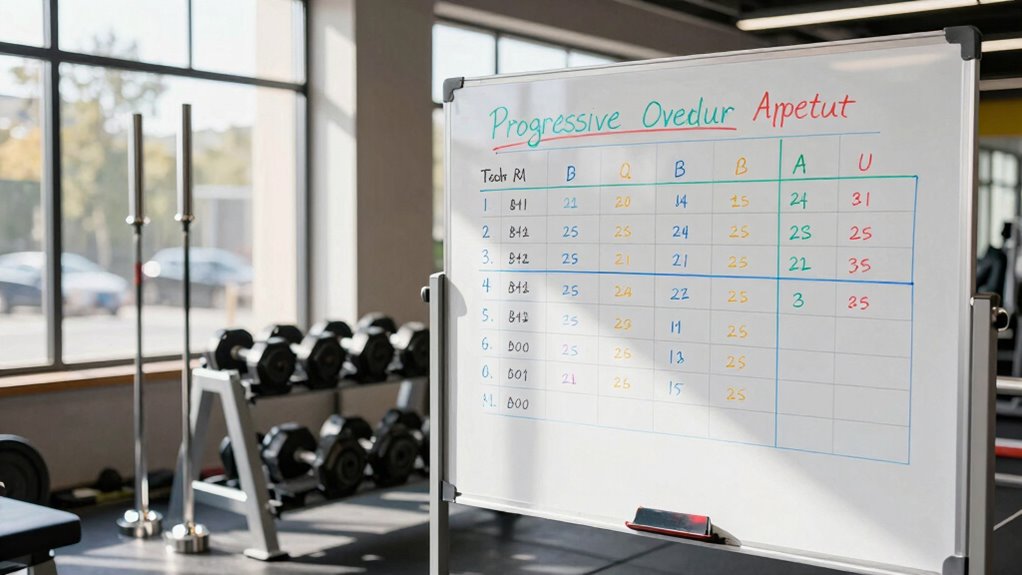
Progressive overload is vital for continuous strength and muscle gains, but knowing how to structure your training can be challenging. One of the most effective ways to guarantee steady progress is by focusing on training consistency. When you stick to a regular workout routine, your body adapts more efficiently, and you build momentum that keeps you motivated. Consistency doesn’t mean doing the same workout every time; it’s about showing up regularly and making incremental improvements. This steady approach helps your nervous system adapt, your muscles grow stronger, and your endurance improve over time. To get the most out of your training, you also need to incorporate workout variation. Sticking to the same exercises and routines can lead to plateaus, where progress stalls because your body has adapted to the stimuli. By varying your workouts—changing the exercises, adjusting the sets and reps, or increasing the intensity—you keep your muscles guessing and promote continual growth.
Additionally, incorporating training periodization can help structure your progressions more effectively, allowing for planned variations that optimize gains while preventing overtraining. A good progressive overload template balances these two principles. For example, you might set a weekly schedule that emphasizes certain compound movements like squats, deadlifts, or bench presses, performing them consistently two or three times a week. On these days, you focus on gradually increasing the weight, reps, or sets, which directly applies the overload principle. To prevent stagnation, you could rotate in accessory exercises or alter the training volume every few weeks. This variation ensures your muscles are constantly challenged in new ways, reducing the risk of adaptation and boredom.
It’s also vital to track your progress and listen to your body. With a structured system, you’ll know when to ramp up the weights or add more repetitions. This tracking makes training more intentional rather than haphazard, which enhances your training consistency. When your workouts include strategic variation, you avoid overtraining specific muscles, giving your body enough time to recover and grow stronger.
As an affiliate, we earn on qualifying purchases.
Frequently Asked Questions
How Do I Customize Templates for My Specific Goals?
You can customize templates for your specific goals through template personalization by adjusting the exercises, sets, and reps to match your target outcomes. Incorporate goal-specific adjustments like increasing weight for strength or adding cardio for endurance. Track your progress regularly and tweak the template accordingly. This way, you stay aligned with your objectives, ensuring your workouts remain effective and engaging, helping you achieve your fitness goals faster.
Can Beginners Effectively Use Progressive Overload Templates?
Did you know beginners can absolutely succeed with progressive overload templates? It’s all about training consistency and staying motivated. These templates simplify increasing intensity or volume, making progression manageable. By following a structured plan, you build confidence and see steady gains. Incorporating motivation strategies like tracking progress or setting small goals keeps you engaged. So yes, even newcomers can effectively use these templates, making their fitness journey both effective and enjoyable.
How Often Should I Update or Change My Template?
You should update or change your template every 4 to 6 weeks to maintain progress and keep workouts fresh. This allows for sufficient flexibility in your template, ensuring continuous challenge without causing burnout. Regular progress tracking helps you identify when adjustments are needed. By monitoring how you’re responding to your current template, you can make informed updates, making your system more effective and sustainable over time.
Are There Templates Suitable for Different Workout Styles?
Yes, there are templates suited for different workout styles. Research shows that matching your training frequency and workout variety to your goals enhances progress. For strength training, templates focus on progressive overload with fewer exercises, while for endurance, they include higher reps and varied movements. Find a system that aligns with your style, and you’ll stay motivated and consistent, making it easier to stick with your fitness journey over time.
What Are Common Mistakes to Avoid With These Templates?
You should avoid overtraining by not increasing your training frequency too quickly, which can lead to injury. Also, don’t neglect injury prevention strategies like proper warm-ups and listening to your body. Steady progression is key, so jump in gradually and stick to the template’s plan. This prevents burnout and keeps you consistent, making it easier to see progress without risking setbacks or injuries.
progressive overload workout tracker
As an affiliate, we earn on qualifying purchases.
As an affiliate, we earn on qualifying purchases.
Conclusion
By sticking with these progressive overload templates, you’ll keep challenging your muscles and prevent plateaus. Did you know that consistent overload increases muscle size by up to 50% over a year? That’s a powerful motivator to stay committed and choose a system that fits your style. With dedication and the right plan, you’ll see steady progress and release your full potential. Keep pushing, and those gains will follow faster than you think.
muscle building resistance bands
As an affiliate, we earn on qualifying purchases.
As an affiliate, we earn on qualifying purchases.
training journal for strength training
As an affiliate, we earn on qualifying purchases.
As an affiliate, we earn on qualifying purchases.
Fall Picks
fall essentials
As an affiliate, we earn on qualifying purchases.